You were outside for 2 hours. It may be due to over-mowing the lawn, waiting for your child’s soccer match, or even waiting in the car park for an errand that wasn’t finished on time. You were outside for two hours. Maybe you were mowing the lawn, waiting at your child’s soccer match, or standing in a parking lot longer than expected.
You are suffering from a headache. The room appears to be a bit crooked. If your tummy is talking you down, and you don’t know if it is going for a pee or something else.
You think, I need just a bit of water.
And honestly? You might be right. But you also might not be and that’s worth paying attention to.
That exact combination of headache, dizziness, and nausea after being in the heat is one of the clearest early signs of heat exhaustion. Most people either push through it or don’t recognize it for what it is until things have gotten worse than they needed to.
According to a CDC Morbidity and Mortality Weekly Report published in April 2024, there were 119,605 emergency room visits across the United States for heat-related illness in 2023 alone — with 92% of those visits occurring between May and September. A research letter published in JAMA in August 2024 found that heat-related deaths in the U.S. climbed from 1,069 in 1999 to 2,325 in 2023 — more than doubling over that period, with the sharpest rise happening in the last several years.
And here in Texas? The Texas Tribune reported that at least 279 Texans died by heat-related illness in one year – the highest number since 1999, when the Texas Department of State Health Services (TDSHS) reported on the statistics.
The goal is not to panic, but to take that pounding headache, dizziness, and nausea seriously. a bit more serious than it is if you didn’t take it!
So, provided that you are feeling unwell in a hot climate, let us clarify what is happening and what you should do if you are feeling unwell – and what you should NOT be doing – at home, as well as when it is appropriate to do so the same day.
Quick Summary: What You Need to Know
- Heat exhaustion happens when your body loses too much fluid and salt through sweating
- The main signs are headache, dizziness, nausea, heavy sweating, and weakness
- This can happen even if you are not exercising; sitting outside on a very hot day can be enough.
- Most mild cases will recover within 1 hour with cooling, rehydration (electrolyte solution), and rest.
- Don’t put it off if symptoms are worsening, vomiting or becoming more confused, seek same day care!
- Heat exhaustion can often be managed when caught early. Heat stroke is a medical emergency. Knowing the difference matters.
Why Does the Heat Make You Feel So Sick?
Here’s what’s actually going on inside your body when this happens.
Your body is constantly trying to keep your core temperature in a safe range. When it gets hot, especially if you’re moving around, your temperature starts creeping up, and your body kicks into cooling mode. You sweat. Blood is forced towards the surface of your skin to give off heat. Your heart beats are accelerated.
That response is normal, but it comes at a cost.
Water loss and loss of electrolytes (potassium, sodium, and chloride) occur during exercise. Upon the first descent, there are features of pounding head, dizziness on standing, stomach ache, and lots of other feelings.
Heat exhaustion is all about it. The CDC clinical guidance of heat illness says that heat exhaustion is just your body’s reaction to the fluid and electrolyte loss. It can take a few days to develop in people who are not accustomed to the heat, and it can be confused with summer flu, as fatigue and weakness are very similar.
Nothing like running a marathon in the sun, working a shift in a poorly vented warehouse, or sitting at an outdoor graduation for a few hours without drinking enough; it’s enough.
The Signs of Heat Exhaustion and Why They’re Easy to Miss
Part of why heat exhaustion catches people off guard is that the symptoms are easy to explain away individually.
- The headache? Probably just the sun.
- The dizziness? I stood up too fast.
- The nausea? Maybe something you ate.
Then, if several of these appear over a period of time after you’ve been in the heat, this is the body’s way of telling you.
As per CDC and National Weather Service guidance, Here are the symptoms and signs of heat exhaustion: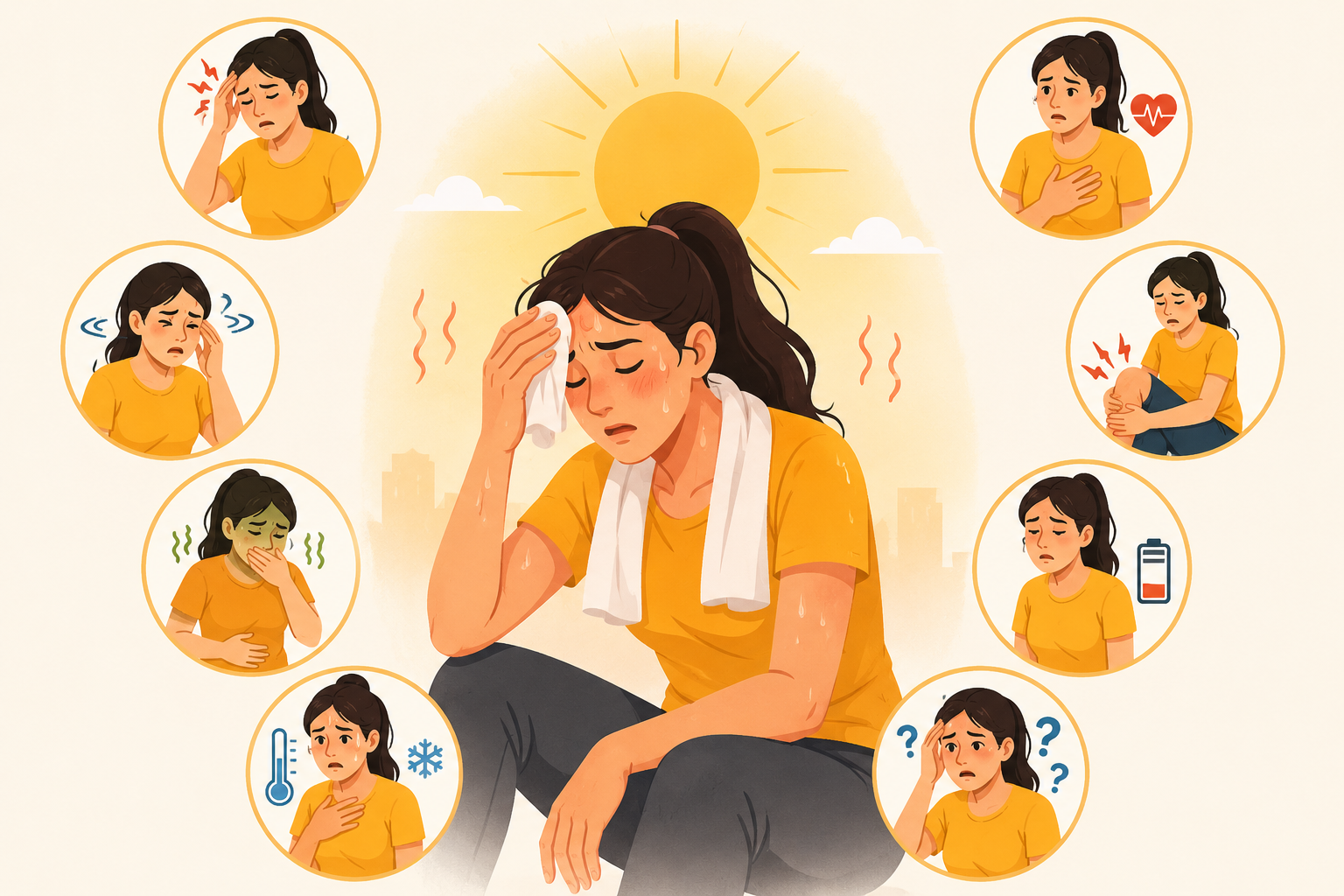
- An aching, pulsating headache – typically behind the eyes or across the forehead. It tends to build the longer you stay in the heat and ease once you’re somewhere cool.
- A headache or blurred vision – especially when standing up or moving quickly. That means they don’t have as much blood to supply the brain as they normally would.
- Nausea, and sometimes vomiting – your digestive system is depriving itself of blood supply, but your body is focusing on cooling itself. Throw in an electrolyte imbalance, and your tummy is not happy.
- Too high a level of sweating and clammy skin- This may be a shock to some. In case of overheating, the person will be cool and dry to the touch, while in heat exhaustion, the skin may be cool and clammy.
- Very quick but weak pulse – the heart is working harder to compensate for decreased blood volume. It speeds up but doesn’t have much force behind it.
- Muscle cramps or sudden weakness – particularly in the legs or abdomen. This may be one of the initial “red flags” that the body gives.
- Sudden fatigue – extreme tiredness. You were a fine young woman, and now you are all worn out.
- Could be irritated or a little confused – may feel a bit short-tempered or confused. That’s okay in heat exhaustion. When it seems to get considerably worse, then it’s time to pay attention.
The one thing you will want to know: Cleveland Clinic reports that your core body temperature in heat exhaustion will normally remain below 104°F. It does not necessarily mean that you have a fever. One of the reasons people don’t take it seriously enough. You don’t feel hot, you feel bad – but it can’t be that bad, right?
Heat Exhaustion vs Heat Stroke: This Is the Part That Really Matters
If there’s one thing to take from this entire blog, it’s this.
Heat exhaustion is serious, but it’s manageable. Heat stroke is an emergency – the kind where you call 911 and don’t wait.
The tricky part is that heat stroke often starts looking a lot like heat exhaustion. The early symptoms are nearly identical like confusion, dizziness, headache, nausea, but they escalate rapidly into something far more dangerous.
The line between the two comes down to one thing: what’s happening with the brain.
Heat exhaustion is when the person feels bad, but not too bad to be able to think straight. They can answer questions, follow instructions, and converse even if they are irritable and confused about minor matters.
With heat stroke, the brain is at risk. We are not talking about dizziness or slurring of your words. We are not talking about dizziness or slurring of speech. Body temperature can increase to 106°F or more in 10-15 minutes, and with emergency treatment, may result in permanent disability or death.
Here’s a side-by-side to keep handy:
| Heat Exhaustion | Heat Stroke | |
| Body temperature | Normal to mildly elevated, below 104°F | 104°F and climbing — fast |
| Skin | Cool, pale, clammy, sweating heavily | Hot, red, dry — or sweating but burning hot |
| Mental state | Foggy, irritable, but still coherent | Severely confused, delirious, unresponsive |
| Nausea | Possible | Common, often severe |
| Sweating | Heavy | May stop entirely |
| Pulse | Fast and weak | Fast and strong |
| What to do | Cool down, hydrate, seek same-day care if not improving | Call 911 right now. Begin cooling while you wait. |
Do not drive to urgent care with anyone else nearby who is now not speaking coherently, collapsed, or not sweating in the heat or burning hot to the touch. Call 911.
If you don’t know what kind of it is, go all out and assume the worst-case scenario. Spending too much caution will never be a mistake with this!
Heat Cramps vs Heat Exhaustion – They’re More Connected Than You Think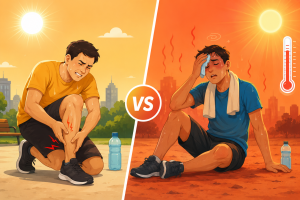
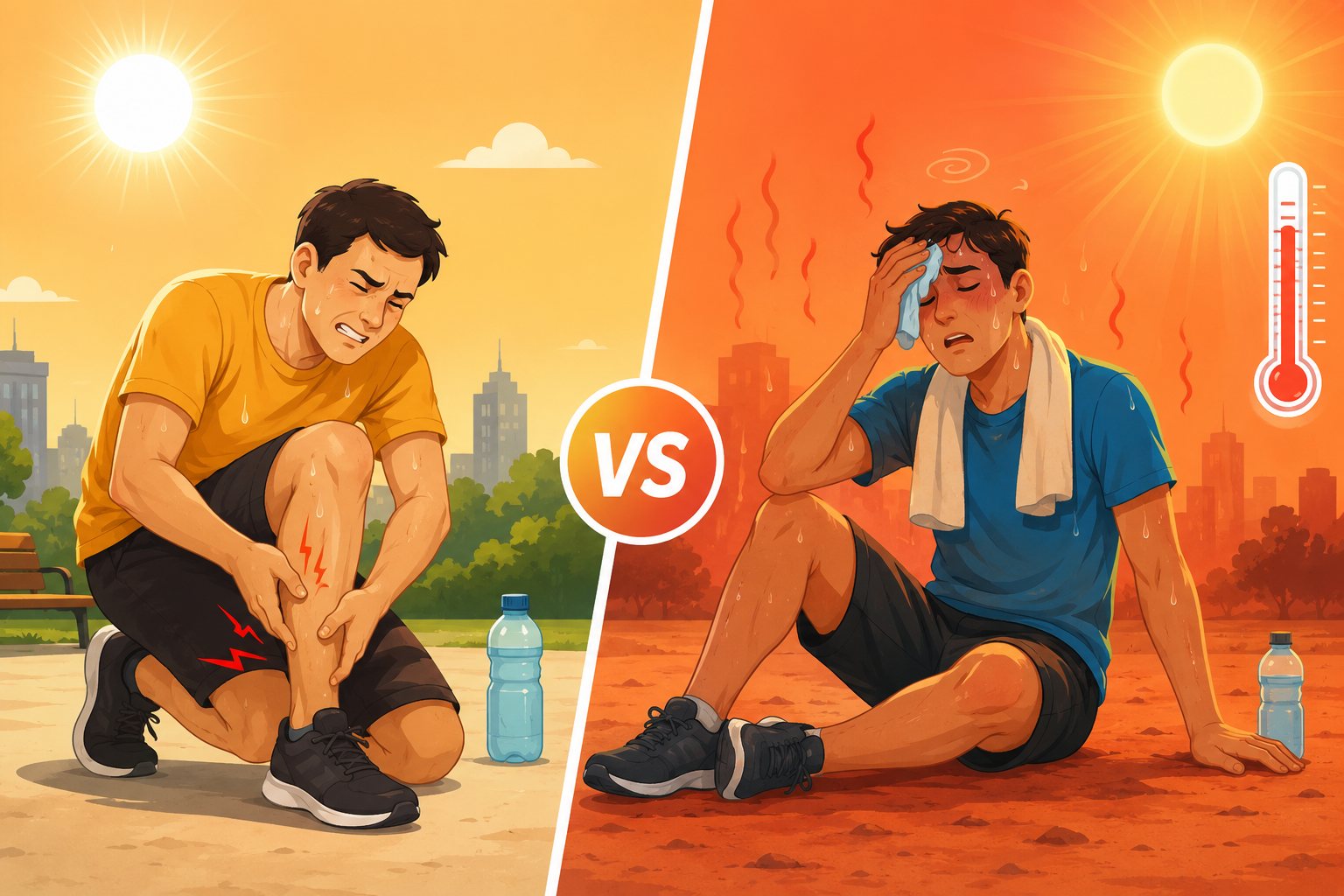
A lot of people get heat cramps where those sharp, involuntary muscle spasms in the legs or stomach and chalk it up to pushing too hard physically.
Sometimes that’s true. However, electrolytic depletion is the cause of heat cramps, just as it is for heat exhaustion. Heat cramps can also be a sign of heat exhaustion, not heat cramps by themselves.
If you are experiencing headache, dizziness, and nausea as well as cramping, you have been on the verge for some time. Such a pairing requires attention – attention in the form of stretching and hoping that it works.
What to Do at Home for Heat Exhaustion Symptoms
There are things that truly work when symptoms are mild, and it happens during the early stages:
Step 1:Get out of the heat and stop activity immediately. That is the one most important aspect that will matter the most. If possible, get to a cool place. Lie down. Avoid doing anything at the moment, as all will still be there later on.
Step 2 – Move horizontally and lift legs up. The blood returns to the brain when you are lying down. Help your legs go up even more. This will directly address the dizziness.
Step 3 – Cool Your Body! Wet cloths on the neck, armpits, and wrists are effective areas — they have blood vessels in close proximity to the surface. If you are able to get to a cool shower, it’s good. Avoid cold water coldly, as it will constrict the blood vessels.
Step 4 – Drink something with electrolytes. Commercial rehydration solutions and sports drinks work better than plain water because they replace the sodium, chloride, and potassium your body lost through sweat. Sip it slowly; don’t chug. And skip the caffeine and alcohol, both of which will make the dehydration worse.
Step 5 – Give it 30 to 60 minutes and be honest about what you see. You should start feeling meaningfully better within that window. If you’re not, if you’re flat, getting worse, or can’t keep fluids down because of nausea, that’s your answer. It’s time to get seen.
A note on the heat exhaustion headache that won’t quit: the throbbing usually comes from dehydration and blood vessel changes in the brain. Rehydrating properly is the most effective fix because it addresses why the headache is there in the first place, not just the pain itself. A dark, cool room and a cold cloth on the forehead can take the edge off while you’re working on rehydrating.
Who’s Most Vulnerable to Summer Heat Illness?
All of this doesn’t matter to the heat, but some of this matters more to the heat.
As people grow older, their body temperature control diminishes, and they aren’t as likely to think that they are thirsty until they are already thirsty. Children (young ones) warm up much more rapidly than adults. People who work in the outside environment – construction, landscapers, farmers, and any outdoor work, which keeps them outdoors in North Texas all summer – are continually exposed and don’t have time to catch their breath. The CDC consistently overestimateshospitalization for HRI and mortality from HRI in adults 65 years of age or older. The CDC consistently overestimates the number of hospitalizations due to HRI and deaths from HRI in adults 65 years of age or older.
The importance of some medicines is greater than they think. A range of medications, such as diuretics, antihistamines, beta-blockers, and some antidepressants, can have an impact on how well you can sweat or deal with heat. You are on one of these, and you need to spend some time outside; your threshold is below average.
The importance of some medicines is greater than they think. Various medications like diuretics, antihistamines, beta blockers and certain antidepressants can affect your sweating and ability to cope with heat. You’re on one of these, and one of these is that you need to get outside and devote a bit of time in there, you have a threshold lower than listed.
The Texas data and the data for the South picture a vivid picture. For the HHS region (Arkansas, Louisiana, New Mexico, Oklahoma, and Texas), the April 2024 CDC MMWR report reported that the number of heat-related ER visits was above 95th percentile of historical heat-related ER visit rates for the past 16 days in July 2023.
According to the study published this past August in the Journal of the American Medical Association (JAMA), U.S. heat-related deaths had more than doubled since 1999, and the toll was likely underestimated. At the same time, CDC said over two thirds of the population in America experienced heat alerts in 2023.
When to Seek Same-Day Care for Heat Exhaustion – Be Honest With Yourself
This is where people get tripped up. Either they wait too long hoping it resolves on its own, or they feel embarrassed about seeking care for something that feels like “just the heat.”
Neither hesitation is worth it. Here’s a straight list of situations where you should get same-day care, not tomorrow, not “let me sleep on it.”
Go to urgent care the same day if: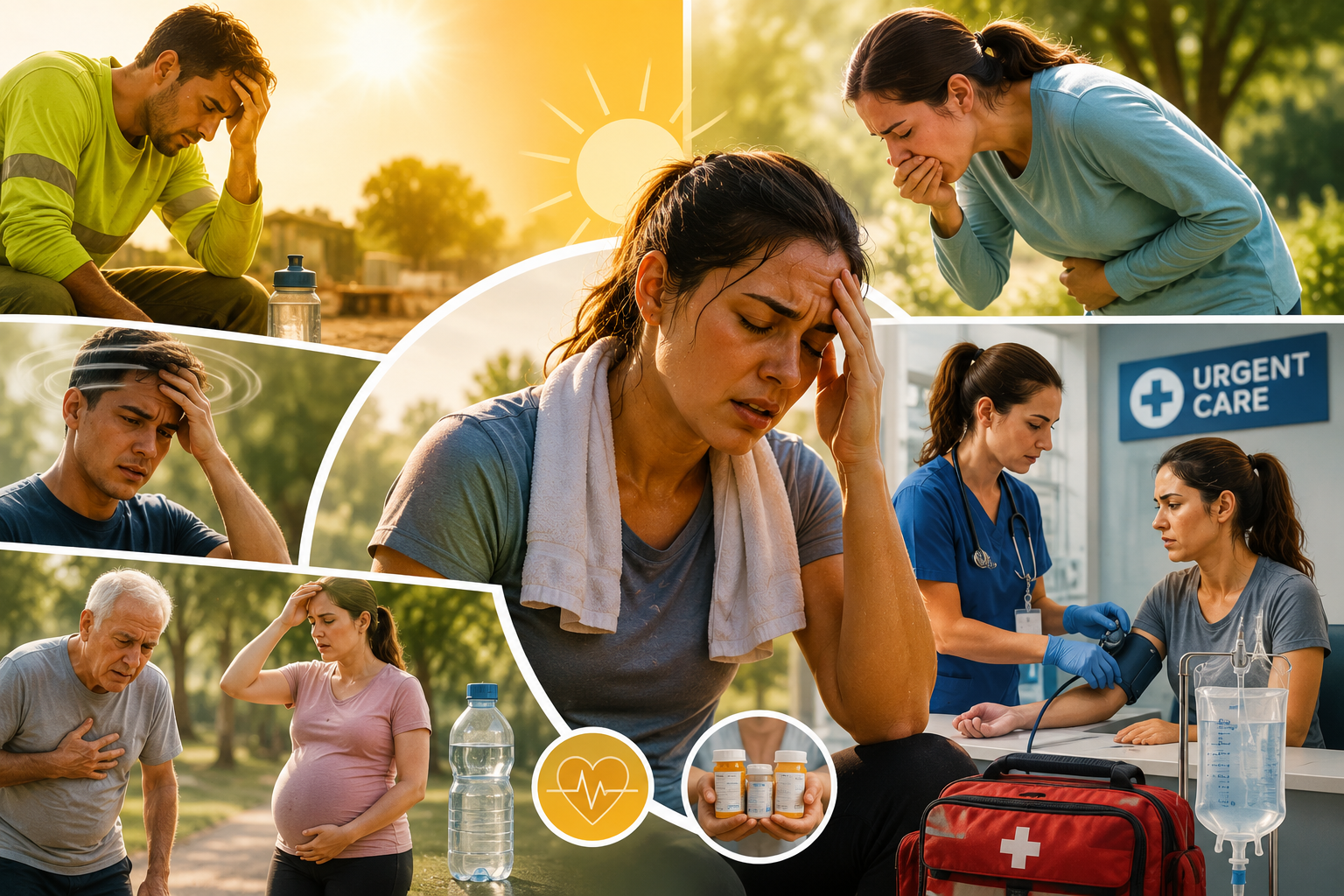
- Symptoms haven’t improved meaningfully after 45 to 60 minutes of cooling down and rehydrating at home
- You’re vomiting and can’t keep fluids down. At that point, oral rehydration isn’t going to work and IV fluids are almost certainly needed
- There’s any confusion, disorientation, or unusual behavior, even mild
- The person is elderly, pregnant, has heart disease, diabetes, or kidney issues, or takes diuretics or blood pressure medication
- You worked outside for most of the day and now have the full picture with headache, dizziness, nausea, and cramping together
- Your headache won’t go away even after hours in the cool with fluids
- You feel dizzy and sick in the sun repeatedly, even multiple times over several days
- Symptoms appeared to improve, then suddenly got worse
According to the National Weather Service heat illness guidance, medical attention should be sought immediately if the person vomits, symptoms worsen, or symptoms last longer than one hour.
At Quick MD Care, you don’t need to sit in an ER waiting room to get this evaluated. Their team can check your vitals, assess your hydration and electrolyte levels, and figure out what your body actually needs the same day.
How Quick MD Care Helps
When home treatment isn’t enough, you need a place that can actually see you today.
Same-Day Primary Care
Quick MD Care’s Primary Care clinic in McKinney offers same-day appointments for patients dealing with heat exhaustion. The physicians don’t just tell you to drink more water, they do a real evaluation, check your vitals, and help you figure out whether you need further treatment or just monitored rest.
Walk in, or call ahead at 972-645-9400.
IV Fluids When You Need Them
If you’ve been vomiting and genuinely can’t keep anything down, drinking your way back to normal isn’t going to happen. Quick MD Care offers IV services that restore blood volume and electrolytes directly; far faster than oral rehydration. This is the same clinical approach recommended in CDC treatment guidance for moderate to severe heat exhaustion.
Adult Wellness Exams for Recurring Issues
If you find yourself consistently feeling sick in the heat every summer despite doing everything right, something else may be contributing to unmanaged blood pressure, blood sugar, or a medication that’s lowering your heat tolerance without you realizing it. Quick MD Care’s Adult Wellness Exam can help identify those risk factors before another hot afternoon turns into an urgent care visit.
Location: 10101 Westridge Blvd, Suite 101, McKinney, TX 75070 Phone: 972-645-9400 Hours: Mon–Sat 8 AM–7 PM | Sun 9 AM–4 PM
5 Questions People Actually Ask
Can heat exhaustion cause vomiting?
Yes, and more often than is imagined. Nausea has been one of the typical symptoms of heat exhaustion, and, for more serious cases, vomiting. Beginning at that point, you are losing even more fluids and electrolytes than from the sweat, and cannot now drink fluids or liquids to replace loss. The National Weather Service warns about vomiting with a special notice of immediate action being required. Avoid waiting it out.
How long does heat exhaustion last?
Most find that they feel much better within 30 minutes to a few hours with proper treatment, cool environment, rest, and electrolyte rehydration. A few tiredness and a mild headache may persist for the day. It should not take more than an hour, unless you’ve started to improve after one hour of the proper actions, or if you are not able to rehydrate because of vomiting.
What’s the actual difference between heat exhaustion and heat stroke?
The primary difference is one between the brain: Neurological. Heat exhaustion makes a person uncomfortable, but it is not a life-threatening condition. Heat stroke: The brain is being affected – severe confusion, slurred speech, seizures, or unconsciousness. Body temperature can rise to 106°F in as few as 10-15 minutes in the case of heat stroke, so that if no steps are taken, there can be serious consequences, such as permanent damage. Err on the side of caution – treat it as the worst one if in doubt.
Why do I get a headache every time I’m in the sun, even briefly?
Where it actually does, but not just when it is hot, the situation is well deserving of an adequate evaluation. If you suffer from chronic low-level dehydration, are sensitive to the temperature effects of medicines, or have any medical problems that affect your heart, you can have a very low tolerance. Increasing the water supply does not necessarily work. A Quick MD Care Adult Wellness Exam may help determine what is really causing it.
Is heat exhaustion the same thing as hyperthermia?
Hyperthermia is a term used to refer to any increase in body temperature above normal. It includes heat exhaustion and heat stroke. Heat exhaustion is a rise in body temperature, but to a lower extent (less than 104°F). This increases in heat stroke, and the brain starts to show signs of dysfunction. The symptoms are also very similar to those of dizziness, headache, nausea, and a fast heart rate. That’s why it’s so important to detect the escalation at an early stage.
Sources
CDC MMWR — Heat-Related Emergency Department Visits, United States May–September 2023 (April 18, 2024)
CDC — Heat-Related Illnesses, NIOSH
CDC Yellow Book — Heat and Cold Illness in Travelers
CDC — Heat Illness Announcement, April 2024
JAMA — Trends of Heat-Related Deaths in the U.S., 1999–2023 (Published August 2024)
National Weather Service — Heat Illness Symptoms and First Aid
HHS — Extreme Heat and Health Equity
Texas Tribune — Texas Heat-Related Death Data
Texas Hospital Association — Heat Safety in Texas
Cleveland Clinic — Heat Exhaustion
Cleveland Clinic — Hyperthermia
Reviewed by the clinical team at Quick MD Care, McKinney and Frisco, TX — May 2026
This article is for general informational purposes and is current as of May 2026. It is not a substitute for personalised medical advice. If you or someone else is having a medical emergency, call 911 immediately.
Don’t Wait If Heat Symptoms Are Getting Worse
It’s easy to assume that when you’re having heat exhaustion, you want it all over. When suffering from heat syndrome, that’s an easy statement to make: “I want to get through with it. When you cause a panic reaction, you not only won’t obtain the desired results, but you’ll also keep spending more fuel. It’s probably nothing. After a bit of water, you’ll feel better.
Sometimes this is the perfect thing to do. If, however, it isn’t, then the chance to get a head start is short.
About QuickMD Care
Quick MD Care is a primary care and pediatric clinic serving families across McKinney and Frisco, TX offering same-day appointments, IV therapy, adult wellness exams, urgent care, and more. Board-certified physicians. Real availability. No ER wait.
 10101 Westridge Blvd, Suite 101
McKinney, TX 75070
 Phone: 972-645-9400
 Website: quickmdcare.com Quick MD Care