Understood. Let me strip everything back and write it the way someone would actually talk, no neat structures, no perfectly balanced sentences, no AI rhythm.
Pool days are genuinely the best part of summer. Until bedtime, anyway.
Your kid was completely fine all afternoon, laughing, splashing, having to be dragged out of the water. Then dinner happens, pajamas are on, and suddenly they will not stop touching their ear. You can tell the crying is real. Well, something definitely hurts them, and they cannot really explain where or why.
So now you are trying to figure out what is going on.
Is it a swimmer’s ear or a regular ear infection? Does it need attention tonight or can it wait until the morning?
Are swimmer’s ear and middle ear infection the same?
The tricky part is that both of these conditions hurt in a similar way, and from where you are standing they can look almost identical. But they are actually very different things, and this matters more than people realize. That is because the treatment that helps one may not help the other.
Getting it wrong can delay relief and keep your child in pain longer than needed.
How common is swimmer’s ear in children?
The CDC estimates that swimmer’s ear leads to about 2.4 million healthcare visits every year in the U.S., with cases increasing during summer months when swimming is more common. The American Academy of Pediatrics also notes that children can be more prone to swimmer’s ear because their ear canals are narrower and water may not drain as easily.
What follows is a plain explanation of what each condition is, how to tell them apart before you even leave the house, and when the situation genuinely calls for getting your child seen that same day rather than waiting.
The short version before we get into it
Swimmer’s ear is an infection inside the ear canal.
It affects the part of the ear canal near the ear opening and is often caused by trapped moisture that allows bacteria to grow.
A middle ear infection, on the other hand, is a completely different thing.
It happens in a different location, behind the eardrum, and it often shows up after a cold, runny nose, or congestion.
The quickest thing you can check at home is the earlobe.
You just need to gently tug it downward. If your child reacts strongly and the pain clearly gets worse, the swimmer’s ear is the likely cause. But, if pulling the earlobe does not really change anything, the problem is probably sitting deeper, behind the eardrum.
Fever with ear pain can point more toward a middle ear infection and should be evaluated by a clinician.
What swimmer’s ear actually is, and why kids keep getting it
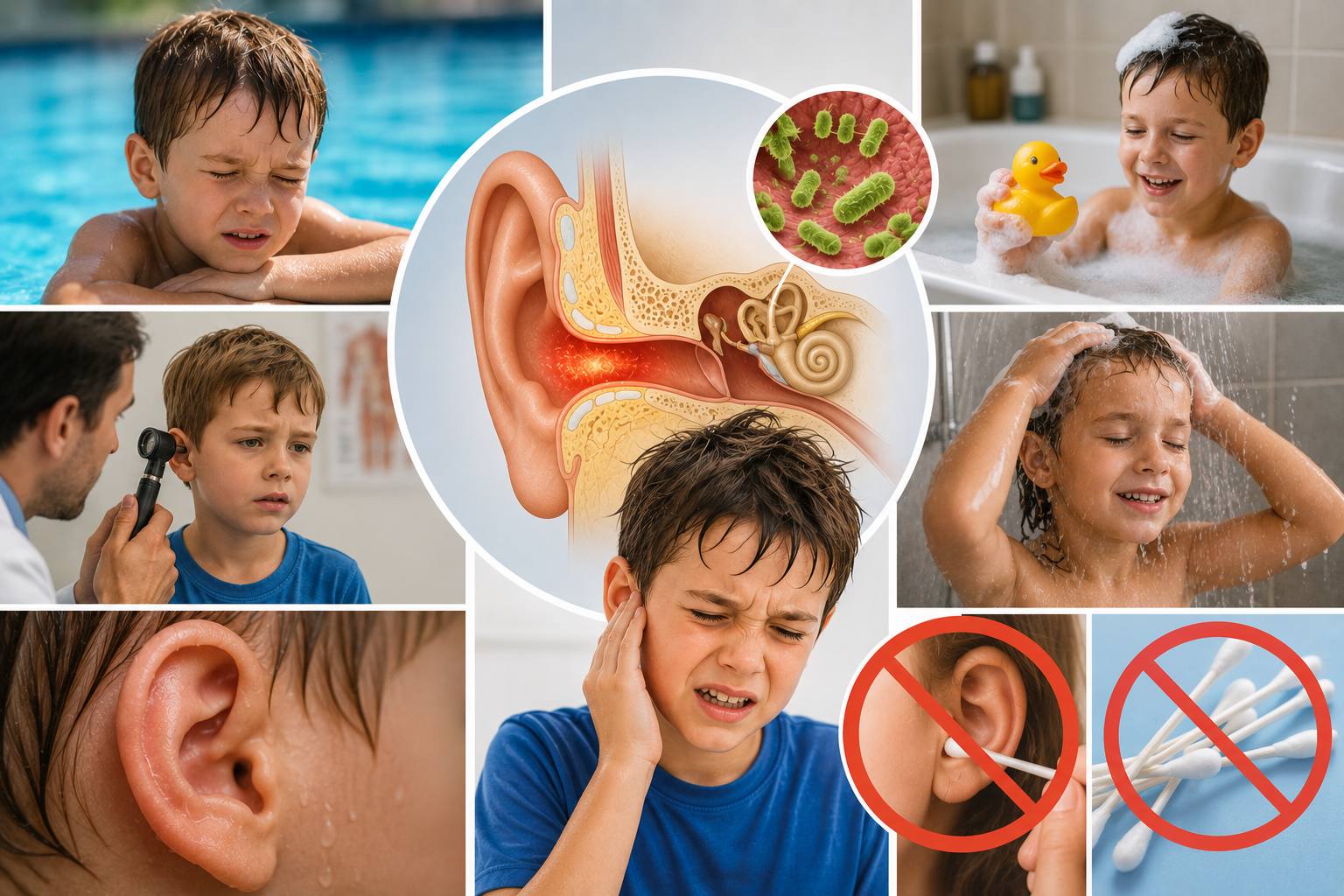
The medical name is otitis externa, which means an infection of the outer ear canal.It is that skin-lined tube running from the ear opening to the eardrum.
It can start simply. Water gets in, does not drain out, and stays in that warm, narrow space.The moisture softens the skin lining the canal, and that creates exactly the kind of environment where bacteria grow quickly.
Children can be more prone to this because their ear canals are smaller, so water may not drain as easily.
One thing that genuinely surprises most parents is that the pool is not the only place this comes from.
The other causes:
- A long bath can do it.
- Rinsing shampoo out in the shower can do it.
- And cotton swabs, which so many parents use thinking they are helping keep the ear clean, can do it too.
Are cotton swabs harmful for kids’ ears?
Cotton swabs can scratch the delicate skin inside the ear canal, and even a small scratch can make infection more likely.The ear actually does a pretty good job of cleaning itself. The swabs mostly just cause problems. And that tiny abrasion leads to bacterial growth.
What Is a Middle Ear Infection, Then?
A middle ear infection, or otitis media, is a completely different situation.
This one happens behind the eardrum, in a small cavity called the middle ear. It almost always develops after an upper respiratory illness like a cold, a virus or congestion. It often develops after an upper respiratory illness, such as a cold, virus, or congestion.
This is the classic toddler ear infection most parents have already lived through. It is the one that shows up a few days after a runny nose and usually comes with a fever and a child who cannot get comfortable.
The National Institute on Deafness and Other Communication Disorders reports that five out of six children have at least one middle ear infection before the age of three. It’s one of the most common reasons children visit a doctor.
Significant differences between swimmer’s ear and middle ear infection
- Do remember, swimmer’s ear is an outer ear canal problem, while a middle ear infection happens behind the eardrum in the middle ear.
- Both occur at the same general area of the head, but at completely different locations, with completely different causes, and completely different treatments.
- Both hurt and both can temporarily muffle hearing. But one needs antibiotic ear drops and the other might need oral antibiotics, and swapping them does not work.
- Ear drops used for swimmer’s ear will not treat an infection behind the eardrum. Oral medication for a middle ear infection may not address inflammation in the outer ear canal.
- Getting them confused delays relief for your child and sometimes makes things worse.
How to Actually Tell Them Apart
Here is the practical part.
The single most useful thing you can do at home is the earlobe test. Here, you will have to gently tug down on the earlobe or press on the small triangular bump in front of the ear opening.
In case your child reacts strongly and the pain gets worse, that’s a sign of a swimmer’s ear.
With a middle ear infection, that same tug typically doesn’t aggravate the pain at all. This is because the problem is too deep inside to be affected by what’s happening on the outside.
Beyond that test
- You need to look at where the pain is – swimmer’s ear pain is near the ear opening and in the canal itself, while the middle ear infection pain is deep inside, near the eardrum, and it often gets worse when the child lies down. This is why it disturbs sleep so badly.
- Look at the outside of the ear – With a swimmer’s ear, the outer ear often looks visibly red and swollen. You can also sometimes find a rash-like around the opening. You might notice drainage too, occasionally with a smell. With a middle ear infection, the outside of the ear looks completely normal. The problem is entirely hidden behind the eardrum.
So, ask yourself what happened in the days before this started.
Was it swimming or bathing recently? Almost certainly it is a swimmer’s ear. If there has been a cold or congestion for the past few days, followed by fever and deeper ear pain, that may point more toward a middle ear infection.
Fever is the other big differentiator. A swimmer’s ear rarely causes a fever, while a middle ear infection commonly does, especially in younger children.
Signs of Swimmer’s Ear in Toddlers Who Can’t Tell You Where It Hurts
This is genuinely the hardest part of parenting a sick toddler. Young children know something hurts, but they cannot explain what or where.
With babies and toddlers, you can look for behavioral signs rather than descriptions.
- Try to notice if they are crying or flinching when you touch the side of the head. This might show up during hair washing, getting dressed, putting a hat on, or just placing their head on a pillow.
- Rubbing the ear against a surface is another one to note.
- One of the other clues in young children is a sudden refusal to eat or chew. This sounds unrelated but it’s actually quite specific to outer ear problems. Chewing presses on the ear canal, and when that canal is inflamed, chewing hurts.
- If there is an unexplained irritability that has no other obvious cause and started after a bath or swim, then it is also worth taking seriously.
What the Early Stages Actually Feel Like
Swimmer’s ear does not always start with dramatic pain the moment your child gets out of the water. It often builds.
- The The first sign may be itching inside the ear canal.
- It may feel like a slightly stuffed-up or itchy feeling that shows up within 12 to 24 hours after prolonged water exposure.
- Kids old enough often say something feels stuck in there, or that the ear feels full or blocked.
- Also, parents tend to dismiss this stage because it doesn’t seem that bad yet.
- Then, over the next couple of days, if no action is taken, that itch can turn into real pain. The canal skin swells, touching the outer ear starts to hurt. Sometimes you might see visible redness around the ear opening.
- If discharge develops, it might be clear or yellowish and can have a noticeable smell.
- When the swelling gets significant, children may also experience temporary muffled hearing on that side.
- It can be frightening for a young child who doesn’t understand what’s happening.
The practical lesson here is not to wait for the dramatic stage.
If your child mentions their ear feels weird or itchy after pool time, that’s the moment to start keeping it dry and watching closely. That’s also the moment where prevention steps like drying drops can still make a real difference.
Does a Swimmer’s Ear Go Away on Its Own?
Sometimes very mild, caught-early cases settle down without treatment. But it’s genuinely not something to count on.
To be honest, trying to manage a swimmer’s ear at home without professional guidance is generally not advisable because it’s a bacterial infection.Without the right treatment, it may get worse rather than better. Also, the longer it goes untreated, the more swollen and inflamed the canal becomes, which actually makes treatment harder.
The CDC confirms that prescription antimicrobial drops are the standard treatment and most children feel significantly better within 24 to 48 hours of starting them. In rare but serious untreated cases, the infection can spread to surrounding tissue or even bone.
This is uncommon, but waiting and seeing isn’t a great strategy here.
When to Take Your Child to the Doctor for Ear Pain After Swimming
Not every ache after the pool needs an urgent visit. But there are situations where the same day is the right call. It shouldn’t be pushed till tomorrow, or after the weekend.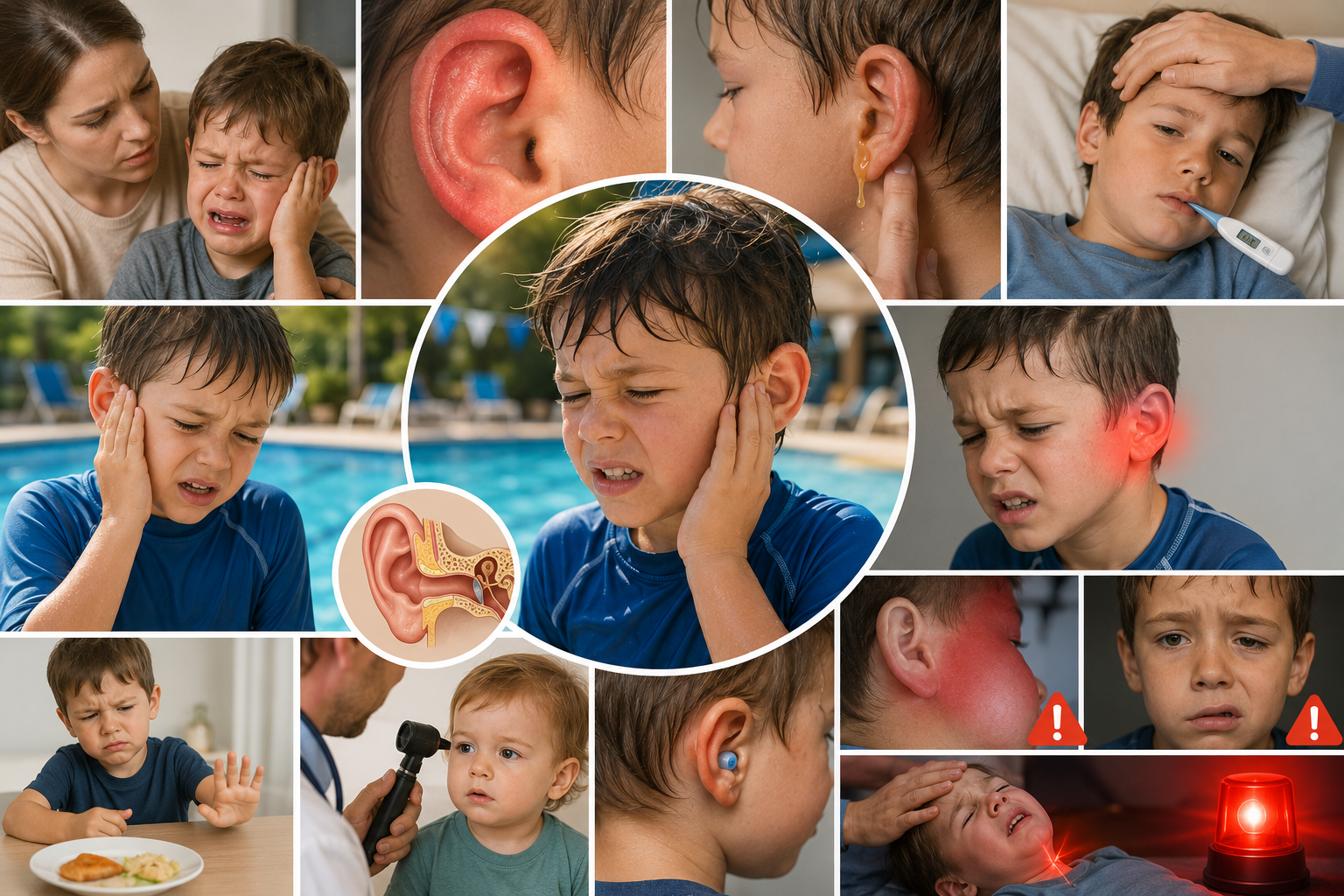
- Get your child seen the same day if they won’t stop crying and the pain is clearly significant.
- Go the same day if the outer ear looks visibly red or swollen around the opening.
- Go if there is any discharge from the ear, especially if it has a smell.
- Go if there is a fever alongside the ear pain, because that combination shifts the picture toward a middle ear infection that needs evaluation.
- Go if the pain is getting worse rather than better over 24 to 48 hours.
- Go if your child is refusing to eat or chew because of the pain.
If your child is under two years old, the ear pain in this age group will always be evaluated in person rather than watched at home. Young children’s ear anatomy is different and they can’t communicate how serious the pain is.
If your child has ear tubes, also get them seen promptly. Water in the ear changes the clinical picture for children who’ve had tubes placed.
Go to the ER or call 911 if the swelling or redness is spreading behind the ear or along the jaw. Go immediately if your child develops any facial weakness. If you see high fever combined with severe ear pain and neck stiffness together, that combination needs emergency evaluation.
The vast majority of swimmer’s ear and middle ear infection cases never go near emergency territory. But those specific warning signs should never be sat on.
What Happens at the Clinic Visit
- When you get your child in, the physician will look into the ear canal with an otoscope to see exactly what’s going on.
- Also, they will ask about recent swimming, bathing, or cotton swab use.
- Additionally, try to also remember whether your child had any cold or respiratory symptoms in the days before. That history is important for figuring out which type of infection this is.
What are the possible treatments
- For swimmer’s ear, the treatment is to apply prescribed antibiotic ear drops three to four times a day for seven to ten days.
- The drops usually contain an antibiotic and sometimes a mild steroid to bring the swelling down faster.
- And, around 90% of cases fully resolve within ten days.
- Also, most children feel noticeably better within the first couple of days of treatment.
- Completing the full course matters even after your child seems fine.
- Stopping the treatment early poses the risk of the infections recurring.
- For pain, age-specific ibuprofen or acetaminophen may be prescribed.
- Also, you can hold a warm compress gently against the ear; it helps.
- Do remember, the ear needs to stay completely dry during treatment.
- More so, ensure no swimming and careful management during hair washing.
- For middle ear infections
- The physician will make the treatment decision based on your child’s age, how severe the symptoms are, and what they see when they examine the ear directly.
- Sometimes, in older children, the infection resolves without antibiotics.
- Your kid might also need oral medication.
- Make sure to follow the advice of a physician who has actually examined the ear, not at home alone.
How to Prevent Swimmer’s Ear Going Forward
The good news is that swimmer’s ear is preventable, and it doesn’t require anything complicated.
- The most important habit you need to follow is drying the ears thoroughly after every swim.
- It’s not just a quick rub with a towel, but a deliberate dry.
- Also, use the corner of a towel to gently wipe around the outer ear, and then tilt the head to each side and pull gently on the earlobe to help water drain naturally.
- Additionally, if you hold a hair dryer on the lowest, coolest setting a few inches away, it can also help dry the canal, especially after longer swims.
- Preventive ear drops are genuinely useful for kids who swim often.
- Make a simple homemade mix of equal parts white vinegar and clean filtered water to drop into each ear after swimming. It also helps dry out residual moisture and keeps the canal acidic. This repels bacteria
- Moreover, over-the-counter preventive drops work on the same principle and are easy to find at any pharmacy.
- As an important suggestion, put the cotton swabs away.
- The CDC is clear: cotton swabs should not go into the ear canal.
- They also don’t clean the ear; rather push wax deeper and scratch the canal skin.
- Earwax is actually protective against infection. So, don’t scratch it.
- If your child swims daily, make sure he/she has properly fitted earplugs.
- Fit is very important here. Poorly fitted plugs can trap water inside rather than keeping it out.
How Quick MD Care Helps With Pediatric Ear Infections in McKinney and Frisco
When your child is in pain at 7 PM on a weekend, the last thing you need is to wait until the following week for an appointment. Quick MD Care is built around the reality that kids get sick outside of regular office hours.
- Same-Day Pediatric Appointments
Quick MD Care’s Pediatric Services team sees children the same day for ear pain, swimmer’s ear, and middle ear infections, for all seven days a week. The physicians do a proper in-person examination. They check the ear canal and eardrum directly with an otoscope, review your child’s recent history, and make an actual diagnosis based on what they see rather than a description over the phone.
Call ahead at 972-645-9400 or walk in at the McKinney clinic.
- Well Child Visits for Kids Who Keep Getting Ear Infections
Some children are just more prone to ear infections than others. They might have narrower canals, lots of time in the water, frequent colds in winter, or a combination of all three. If your child has been enduring ear infections repeatedly, that pattern deserves a proper treatment rather than just treating each episode separately.
Quick MD Care’s Well Child Visits are the right setting to review that history, understand what’s driving the recurrences, and put a real prevention plan together.
- Vaccinations That Reduce Ear Infection Risk
This one genuinely has been highly beneficial to many parents. Certain vaccines, particularly the pneumococcal vaccine and the annual flu vaccine, meaningfully reduce the risk of middle ear infections in children. They do this by protecting against the bacterial and viral causes that most commonly trigger these infections in the first place. Quick MD Care’s vaccination clinic keeps your child’s immunizations current year-round.
Location: 10101 Westridge Blvd, Suite 101, McKinney, TX 75070 Phone: 972-645-9400 Hours: Monday through Saturday 8 AM to 7 PM, Sunday 9 AM to 4 PM Book online at quickmdcare.com
5 Questions Parents Actually Google at Midnight
My child’s ear hurts after swimming — what do I do first?
Start with the earlobe test. Tug gently down on the earlobe. If that makes the pain noticeably worse, swimmer’s ear is the most likely culprit. Keep the ear dry, give age-appropriate ibuprofen or acetaminophen for the pain, and get them seen the same day if the pain is significant or they can’t settle. A swimmer’s ear should be evaluated by a physician who can prescribe the appropriate antibiotic drops. Home treatment without a diagnosis usually isn’t enough.
How do I know if it’s swimmer’s ear or a regular ear infection?
Look at what happened before it started. Swimming or bathing recently, the outer ear looks red or swollen, and touching it hurts? Swimmer’s ear. A cold and congestion for a few days, now a fever, and the pain is deep inside getting worse at night? Middle ear infection. The location of pain, how the earlobe test goes, what the outer ear looks like, and what happened in the days before are the four most reliable ways to tell them apart before you even reach a clinic.
Does a swimmer’s ear go away without treatment?
Very mild early cases occasionally do. But don’t try to manage it without professional guidance. Swimmer’s ear is a bacterial infection, and without the right antibiotic ear drops it tends to worsen rather than improve. The CDC confirms that prescription antimicrobial drops are the standard treatment, and most children feel significantly better within 48 hours of starting them. Waiting it out risks the infection progressing and becoming more difficult to treat.
My child’s ear is swollen after swimming — is that serious?
Visible swelling around the ear opening means the infection has progressed and the canal is inflamed. That needs same-day care. Not because it’s an emergency in most cases, but because a physician needs to assess how significant the swelling is and whether the canal is partially obstructed, and then prescribe the right drops. Don’t wait on visible swelling, especially in younger children.
Can swimmer’s ear cause permanent hearing problems?
In the vast majority of cases, no. The muffled or blocked hearing that comes with a swimmer’s ear is temporary and resolves as the swelling clears with treatment. However, repeated or untreated infections can cause the ear canal to narrow over time, making future infections more difficult to manage. In rare untreated cases, the infection can also spread to surrounding tissue. Prompt treatment matters, even when the initial symptoms seem manageable.
Sources and Clinical References
CDC — Preventing Swimmer’s Ear, Healthy Swimming Program
CDC — Swimmer’s Ear Annual Healthcare Visits and Costs
American Academy of Pediatrics — Swimmer’s Ear in Children, HealthyChildren.org
National Institute on Deafness and Other Communication Disorders — Ear Infections in Children
Allina Health — Swimmer’s Ear vs Ear Infection: Four Ways to Spot the Difference
Blueberry Pediatrics — Swimmer’s Ear in Children: Symptoms, Treatment and Prevention, medically reviewed November 2025
Mayo Clinic — Swimmer’s Ear: Symptoms and Causes
Cleveland Clinic — Swimmer’s Ear (Otitis Externa)
Minnesota Department of Health — Swimmer’s Ear (Otitis Externa)
Reviewed by the clinical team at Quick MD Care, McKinney and Frisco, TX — May 2026
This article is for general informational purposes and is current as of May 2026. It is not a substitute for personalized medical advice. If your child is experiencing a medical emergency, call 911 immediately.
Your Kid Doesn’t Have to Hurt Through the Night
Ear pain after swimming is one of those summer realities. It happens, it’s common, and it responds quickly to the right treatment. Most kids feel like themselves again within a day or two of starting medication.
The part that doesn’t have to happen is lying awake wondering which infection it is, trying to manage it at home with the wrong approach, or waiting three days for an appointment when you can get seen today.
Book a same-day pediatric appointment at quickmdcare.com or call 972-645-9400. Same-day slots are available seven days a week.
Walk in anytime at Quick MD Care, 10101 Westridge Blvd, Suite 101, McKinney, TX 75070. Open Monday through Saturday 8 AM to 7 PM and Sunday 9 AM to 4 PM. Serving McKinney, Frisco, and families across North Texas.
Quick MD Care is a primary care and pediatric clinic serving families in McKinney and Frisco, TX. Same-day appointments, pediatric care, vaccinations, well child visits, and urgent care — with board-certified physicians who treat your kids like their own.
About QuickMD Care
Quick MD Care is a primary care and pediatric clinic serving families across McKinney and Frisco, TX offering same-day appointments, IV therapy, adult wellness exams, urgent care, and more. Board-certified physicians. Real availability. No ER wait.
 10101 Westridge Blvd, Suite 101
McKinney, TX 75070
 Phone: 972-645-9400
 Website: quickmdcare.com Quick MD Care