
Intro
It usually happens fast. A misstep on the soccer field. A bad landing off a trampoline at camp. A wrist that catches all the weight in a wipeout off a bike.
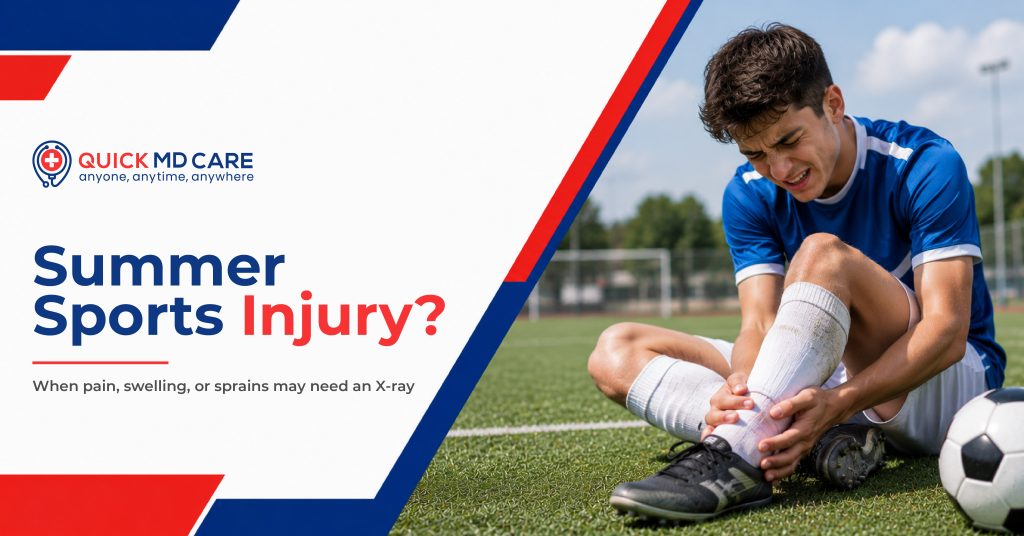
One minute the kid is fine. Next, they’re sitting on the curb holding an ankle, trying not to cry. And every parent in that moment thinks the same thing – is this a sprain, or is it something worse?
More than 40% of childhood injury ER visits occurs between the months of May and August. Over 775,000 children younger than 14 will be seen for sports-related injury in an ER each year. That, alone, would likely put five million other children needing to be seen at a primary care sports medicine office or other sports injury setting. Summer sports injuries are notorious for their commonality, and you’ll no doubt deal with at least one sports injury over the years with your child.
The challenge is that you must learn what is an injury that can wait until morning, and what warrants an X-ray today.
The short version:
- Most sprains will get better with rest, ice, and compression in 48 to 72 hours.
- An X-ray is indicated for a joint that hurts, is swollen, the patient can’t bear weight on, has visible deformity or has a loss of sensation.
- A child is not a small adult: A fracture can look exactly like a sprain in an adult in a growing child.
- When in doubt get it checked: A 15 minute visit saves potentially weeks of wondering.
Why Summer Is Different
Kids move more in summer.
School ends. Camps start. Travel teams ramp up. Backyard trampolines come out. Bikes and scooters are everywhere. And the structured supervision that came with PE class and recess monitors is suddenly replaced with “go outside until dinner.”
Falls alone account for nearly 30% of pediatric trauma cases, and a huge chunk of those happen during the warm months. Summer camp injuries are a category of their own. Kids play harder, play on surfaces they’re not accustomed to, and may be getting less rest than necessary.
If you feel like it’s every other week that your child is dealing with another sprained finger, swelling ankle, or jammed wrist; you’re not just feeling that way, you’re actually seeing it as it really is.
The Most Common Summer Sports Injuries in Kids and Teens
Some are unmistakable. Some look harmless and turn out to be the bigger problem. The ones pediatric providers see again and again:
- Ankle sprains — by far the most frequent. A roll, a twist, a bad landing. The sprained ankle in a child is the classic summer injury.
- Wrist and hand injuries — usually from a fall on an outstretched hand. Wrist injury in kids often gets brushed off, then it doesn’t heal right.
- Knee injuries — soccer, basketball, gymnastics, anything with sudden pivots. Knee injuries in teens especially are climbing as sports get more intense earlier.
- Finger and toe injuries — jammed fingers from basketball, stubbed toes that swell to twice the normal size.
- Concussions — 283,000 kids visit the ER each year for sports- or recreation-related traumatic brain injuries.
- Shoulder injuries — from baseball pitching, swimming overuse, falls.
- Growth plate injuries — the sneaky ones. More on these below.
What makes child sports physicals different from adult ones isn’t always the type — it’s how a growing body responds to them. And that changes the rules.
Why Kids Aren’t Just Small Adults (The Growth Plate Thing)
Here’s the piece a lot of parents don’t realize. Kids and teens still have growth plates. These are soft cartilage zones near the ends of their long bones, where new bone is being made.
It’s important that your child have rest. A child’s growth plates are less resilient than the surrounding ligaments. So the twist in the ankle that would tear the ligament for you might just break the growth plate for the child.
A growth plate fracture might be as indistinguishable from a sprain for the child, as it is to you. They could include pain, swelling, point tenderness and an inability to bear weight. The only way you will ever know if there was a growth plate fracture is with imaging.
This explains why many pediatricians will take a cautious approach to children’s pain where “it just looks like a sprain.” Missed growth plate fractures in childhood can have impact on long-term bone growth.
Sprain vs. Fracture: What Parents Can Actually Tell at Home
The honest answer? Not always much. The signs overlap more than people think. But there are useful clues.
Signs that lean toward a sprain:
- Pain that improves slowly over the first day.
- Swelling that’s noticeable but stays localized.
- The child can put some weight on the limb, even if it’s tender.
- Bruising appears but doesn’t spread fast.
- Point tenderness is along the soft tissues of a joint, not over a bone.
Signs that lean toward a fracture (or warrant an X-ray):
- These findings are more likely a fracture (or require an X-ray)
- There is sharp, direct pain over a bone, and not simply at the joint.
- You see visible deformity where the limb looks bent, crooked, or out of place.
- If there is inability to bear any weight at all.
- You find a swelling that grows fast and massive within minutes.
- There is loss of sensation, and/or color change in your fingertips and toes.
- There has been no improvement at all, even after 48 to 72 hours of rest, ice, and compression.
The Urgent Care Group puts it simply. If you’re asking the sprain vs fracture in kids question and the answer isn’t obvious, that’s usually the answer. Get it imaged.
When Pain and Swelling Mean It’s Time for an X-Ray
Some red flags really aren’t worth waiting on. If any of these are happening, plan for imaging:
- Severe, sharp pain directly over a bone, not diffuse joint ache.
- The child refuses to bear any weight, even with help.
- The child is unable to walk without a significant limp two days post injury.
- There is gross, unrelenting swelling that continues to increase, and that has not begun to decrease after 24 to 48 hours.
- There is visible deformity to the affected area-angles, bends or bumps that were not there before.
- There is pain that wakes the child at night or keeps getting worse instead of improving.
- The bruising develops quickly and unexpectedly-sometimes appearing quite distant from the actual point of trauma.
- There is a sensation or experience of loss of feeling or coldness past the injured site.
- Swelling that is not improving despite rest, ice and elevation after 2-3 days.
Your child falls on their ankle, it swells to the size of a softball? Go for imaging. A kid cannot walk after an ankle injury even after icing it for an hour? Imaging is needed. Child wrist pain after falling that’s still there the next morning? The pediatrician will ask for imaging.
X-rays are quick, painless, and very low radiation. They’re a small task to rule out something that could need a cast.
What to Do in the First 24 Hours
No matter what kind of sports injury you suspect, even one that will ultimately require an X-ray, there is basic at-home care you should provide while you try and figure out what you should do.
The RICE protocol, kid-friendly:
- Rest – stop the activity. Keep weight off the injured area.
- Ice -15-20 minutes at a time, wrapped in a thin towel, every couple of hours for the first day.
- Compression – a snug (not tight) elastic wrap if there’s swelling. Loosen it if fingers or toes get cold.
- Elevation – prop the injured limb above heart level when possible.
Add to that:
- Hold off on heat for the first 48 hours. Heat increases swelling early on.
- Skip massage and stretching until a provider says it’s safe.
- Use children’s ibuprofen or acetaminophen for pain, age-appropriate dose only.
- Watch the symptoms. If they’re not improving by hour 48, that’s the signal to get it checked.
Kids bounce back fast. That’s both their advantage and a problem. A child will often start using a hurt arm again before it’s fully healed, which makes it easy to miss something that should’ve been imaged.
Mistakes Parents Make (Without Realizing It)
A few patterns show up over and over:
- Assuming “it’s just a sprain” because the child can wiggle their fingers or toes. Movement doesn’t rule out a fracture.
- Waiting too long. Twenty-four hours of monitoring is fine. Five days isn’t.
- Skipping the visit because the child stops complaining. Kids adapt quickly to pain. Reduced complaints don’t mean reduced injury.
- Treating a possible growth plate injury with just ice and rest. These can look mild but cause real problems if missed.
- Going straight back to sports too soon. “He feels better” isn’t the same as “he’s healed.”
- Ignoring bruising patterns. Sports injury bruising that spreads down a limb or appears in a different spot than the injury can signal something deeper.
- Forgetting that head injuries don’t always show right away. Concussion symptoms can develop hours later.
When to Stop Watching and Start Driving
Some things shouldn’t sit overnight. Get a provider involved, same day, or sooner, if:
- The child can’t move the joint or limb at all.
- The injury is to the head, neck, or back.
- There’s no loss of consciousness, even briefly.
- The skin is broken over a swollen area.
- There’s significant deformity.
- Pain is severe and not responding to age-appropriate medication.
- A younger child is inconsolable about the pain.
For everything else, the persistent limp, the swollen wrist that won’t go back down, the ankle that’s been bothering them since Tuesday. Here, a pediatric sports injury evaluation at a clinic is the right move. It’s faster than the ER, usually has on-site X-ray, and is built for exactly this.
How QuickMD Care Handles Sports Injuries
For families in McKinney, Frisco, Allen, and Plano, QuickMD Care is set up to take care of these visits without sending everyone to the hospital ER.
What’s actually useful in practice:
- On-site X-ray imaging — no separate trip to a radiology center for most injuries.
- Same-day appointments for sports injuries — the kind of visit that can’t wait until Monday.
- Pediatric care providers who handle kids’ injuries day in and day out, including growth plate concerns.
- Splinting, bracing, and wound care done in-clinic when needed.
- Follow-up coordination if a referral to orthopedics is the right call.
- Primary care services for older teens and young adults still in school sports.
A real pediatric doctor for sports injury evaluation changes your stressful afternoon into a manageable one. So, no second guessing!
Questions Parents Actually Ask
1.How do I know if my child has a sprain or fracture?
It is difficult to know the difference without an X-ray at home. If the child has significant pain or swelling, is unable to put weight on the extremity, or there is any deformity, then assume the child will need to be imaged.
2.At what point should my child get an X-ray for a sports injury?
The child should receive an X-ray within 24-48 hours if their condition is not improving. Treatment should be considered within 24 hours if the child is unable to bear weight on the injured limb, the child is in significant pain over the bone, or if there is any deformity. A same day visit for imaging is appropriate for head, neck, and back injuries.
3.When should my child receive an X-ray after a fall?
All children who fall onto an outstretched arm will need to be evaluated with imaging if they have wrist pain, All falls with possible head impact should be medically evaluated, especially if there is headache, vomiting, dizziness, confusion, sleepiness, or loss of consciousness., and children unable to bear weight on a leg following a fall will need imaging.
4.My child fell and has swelling to their ankle, now what?
Ice, elevate, compress, and monitor. You may go get an X-ray if their swelling is still significant after a day or if their pain does not allow them to ambulate.
5.Kids cannot walk after an ankle injury, is that always a fracture?
Not always. Severe sprains can also prevent weight-bearing. But the only way to be sure is imaging.
6.Child wrist pain after falling, should I wait?
To be honest, wrists are one of the most-missed out pediatric fractures. If pain persists for more than 24 hours, it’s important to get it imaged.
7.Swelling after a sports injury isn’t going down; what does that mean?
Could be a more serious soft-tissue injury, could be a fracture. Two to three days of significant swelling without improvement is a get-it-checked situation.
8.Is the X-ray safe for a child?
Yes, pediatric imaging utilizes extremely low radiation doses and is only performed when absolutely indicated for diagnostic reasons that significantly outweigh the minimal radiation exposure; shielding is provided.
9.My kid has bruising and swelling after an injury but seems fine. Should I still go?
Probably worth a visit, especially if the bruising is spreading or in an odd location. Kids hide pain better than parents expect.
Need an X-Ray for Your Child’s Injury Today?
QuickMD Care helps families avoid unnecessary waiting and second guessing. Our team can evaluate sports injuries, ankle sprains, wrist injuries, swelling, bruising, growth plate concerns, and possible fractures. When imaging is needed, on-site X-ray makes the visit easier and faster for parents. Call QuickMD Care at (972) 645-9400 or schedule a same-day pediatric injury visit online.
Trust and Expertise
A pediatric sports injury evaluation isn’t a glorified glance at a swollen ankle. It’s a structured exam with palpating the bones, testing range of motion, checking ligament stability, and ordering imaging when something doesn’t add up.
The American Academy of Pediatrics, the American Medical Society for Sports Medicine, and St. Louis Children’s Hospital all publish guidance on pediatric sports injuries and they all point to the same core principle: kids’ injuries deserve a pediatric lens, not an adult one. In here, growth plates, developmental considerations, and age-specific recovery times are all important.
A good clinic for child sports injury X-ray is the one which has medical providers who treat these injuries every week. The pediatricians use imaging on-site with immense patience to actually examine the kid instead of glancing at the form.
Ready to Get It Checked?
If something’s not right, don’t sit on it for another day.
Call QuickMD Care in McKinney at (972) 645-9400 or book a same-day pediatric sports injury appointment online. On-site X-ray, pediatric providers, and same-day availability the things that actually matter when a kid is hurt.
More From QuickMD Care
Pediatric care, well-child visits, and immunizations in McKinney: Pediatric Care
Primary care and wellness exams for teens and adults: Primary Care Services
Full list of clinic services: Services Overview
Best School Physicals in McKinney, TX: Your Complete Guide:
https://www.quickmdcare.com/best-school-physicals-in-mckinney-tx-your-complete-guide/
Top 10 Budget-Friendly Protein Foods for Toddlers: Dietary Consult in McKinney, TX:
https://www.quickmdcare.com/top-10-budget-friendly-protein-foods-for-toddlers-dietary-consult-in-mckinney-tx/
Why Prenatal Visits Near McKinney, TX Are a Lifeline for Expecting Moms:
https://www.quickmdcare.com/why-prenatal-visits-near-mckinney-tx-are-a-lifeline-for-expecting-moms/
Well Child Care: Why Regular Checkups Matter for Your Child’s Health:
https://www.quickmdcare.com/well-child-care/
10 Iron-Rich Foods for Adults in 2026: Boost Your Energy and Health: https://www.quickmdcare.com/10-iron-rich-foods-for-adults-in-2026-boost-your-energy-and-health/
AAP Releases its Recommended 2026 Childhood and Adolescent Immunization Schedule – Don’t Miss:
Swimmer’s Ear vs. Ear Infection in Kids: Summer Signs Parents Shouldn’t Ignore : https://www.quickmdcare.com/swimmers-ear-vs-ear-infection-in-kids-summer-signs-parents-shouldnt-ignore/
Bottom Line
Sports injuries are quite common in children and adolescents throughout the summertime and can be treated, although somewhat frustratingly, with a bit of care and patience. The hard part isn’t treating them. It is about knowing which ones to treat at home and which ones need an X-ray.
The rule of thumb stays simple: if the pain is severe, the swelling won’t quit, the kid can’t walk on it, or something just doesn’t look right — get it imaged. Growth plates don’t forgive being ignored. A thirty-minute appointment today will prevent a lengthy consultation with an orthopedist three months from now; an orthopedist can readily make it easier with Quick MD Care of McKinney offering same day appointments and in house imaging with a pediatric specialty.
About QuickMD Care
Quick MD Care is a primary care and pediatric clinic serving families across McKinney and Frisco, TX offering same-day appointments, IV therapy, adult wellness exams, urgent care, and more. Board-certified physicians. Real availability. No ER wait.
10101 Westridge Blvd, Suite 101
McKinney, TX 75070
 Phone: 972-645-9400
 Website: quickmdcare.com Quick MD Care