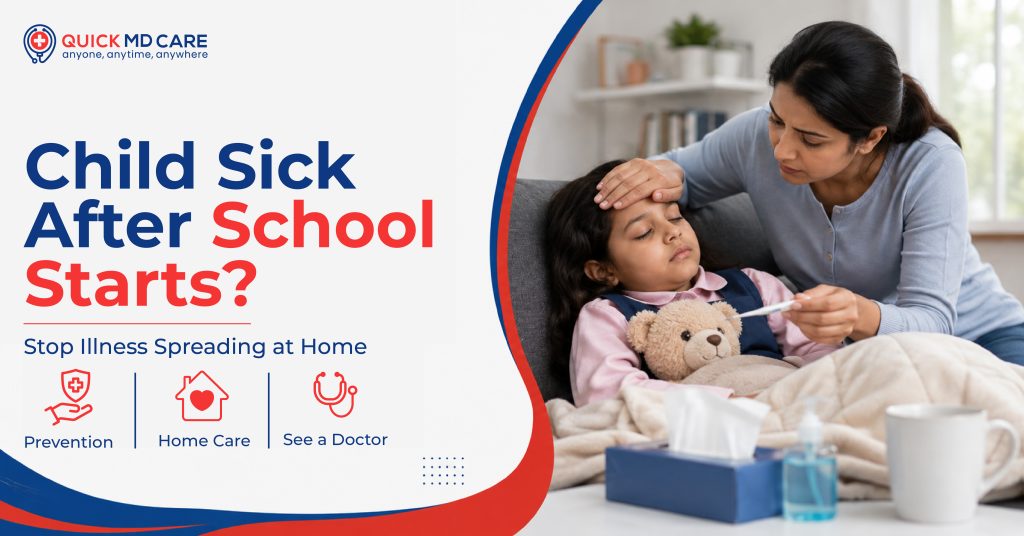
It happens every year, and it happens fast. Your kid was fine on Monday. By Wednesday they’re on the couch with a fever. By the weekend, the little one is coughing and you feel a scratch in your throat.
If you’ve been there, you’re not alone. This past respiratory season was rough on kids, pediatric flu hospitalizations hit their highest peak since 2010-2011, and 149 children died from flu by early February, most of them not fully vaccinated. Add RSV, colds, and stomach bugs, and it’s a lot to manage.
So let’s talk about the two things that actually help: slowing the spread once one kid is sick, and knowing when it’s time to call the pediatrician.
Why kids catch everything the second school starts
Schools are just really good at spreading germs, and some respiratory infections can spread before symptoms even show up.Which is why the kid who looked fine at drop-off can hand something to five classmates before lunch.
A few reasons this hits so hard in fall:
- Little kids touch their faces frequently throughout the day.
- Immune systems are still meeting new viruses.
- Snacks, water bottles, and pencils get shared constantly.
- First-year preschoolers and kindergarteners can catch 8-10 colds a year.
Kids new to school get sick more. Their immune systems just haven’t met the local viruses yet. It gets much better in year two.
What kids actually bring home
Knowing which illness is which helps you decide what to do next.
- Common cold – runny nose, sneezing, mild sore throat, maybe a low fever. Clears in about a week.
- Flu – sudden high fever, deep cough, body aches, exhaustion. Hits fast and hard.
- RSV – often starts like a cold, but some children develop wheezing, fast or difficult breathing, and ribs pulling in with each breath. Especially concerning in babies and toddlers.
- Strep throat – sudden severe sore throat, fever, swollen glands, sometimes white patches. Usually no cough or runny nose (that mismatch is the clue).
- Stomach bug – vomiting, watery diarrhea, cramps, sometimes fever. Usually done in 1-3 days.
Two numbers worth pausing on: about 90% of pediatric flu deaths this season were in kids who weren’t fully vaccinated, and strep stays contagious until roughly 24 hours after starting antibiotics.
Signs your child is too sick for school
Every parent has been on both sides of this one. Here’s what most pediatricians and schools agree on.
Keep them home for:
- Fever of 100.4°F or higher
- Vomiting or diarrhea in the last 24 hours
- Persistent cough or trouble breathing
- Unexplained rash or pink eye with drainage
- Active infection needing antibiotics – until on them for 24 hours
- Real exhaustion, not just tired
The 24-hour fever rule is one a lot of parents miss: in general, a child should be fever-free for a full 24 hours without fever-reducing medication before going back.If the fever comes back once the Motrin wears off, they aren’t ready.
Also useful, the eye test. If they’re on the couch and not asking for the iPad, something’s actually wrong.
When to actually call the doctor
Most childhood illnesses ride themselves out. Some don’t.
Call the doctor when:
- Fever – 100.4°F or higher in a baby under 3 months, repeatedly above 104°F in older kids, or lasting more than 3 days
- Cough – getting worse instead of improving, fast or labored breathing, wheezing (especially in babies), or chest pain
- Sore throat – severe throat pain with fever and no cough (get strep tested)
- Vomiting – nothing staying down for 4-6 hours, or dehydration signs like dry mouth and no urine for 6+ hours
Dehydration is the piece to watch closely. Little kids dehydrate fast, and it’s usually what turns a stomach bug from rough to serious.
For McKinney families, QuickMD Care’s pediatric team offers same-day pediatric appointments with on-site rapid testing for flu, strep, RSV, and COVID, so you leave with an actual answer, not a wait-and-see.
How to stop germs spreading at home
You can’t prevent every school illness. But once one kid is sick, you can absolutely slow the chain reaction.
- Separate what you can – sick child in one main spot, different bathroom if possible, no shared towels, cups, or utensils
- Wash hands properly – 20 seconds, soap and water, especially after coughing or before eating (sanitizer doesn’t work as well against norovirus)
- Teach elbow coughs and sneezes – feels awkward at first, becomes a habit fast
- Wipe down high-touch surfaces daily – doorknobs, light switches, remotes, phones, faucet handles, fridge door
- Ventilate – crack a window when weather allows, or run an air purifier
- Wash bedsheets and towels regularly and dry them completely after use
The surface piece is the one most families skip. It’s where a lot of the transmission actually happens.
How to keep siblings from getting sick
Honest answer? You probably can’t stop it every time. But you can shift the odds.
- Handwashing goes up for everyone the second one kid starts sniffling
- Cups get tracked more carefully
- Sick child eats at a slight distance if possible
- Skip goodnight kisses for a few days
The biggest lever, though, is flu shots for everyone in the household who can get one, ideally in September or October. When 90% of pediatric flu deaths this year were in unvaccinated kids, that shot is doing real work.
Why is my child always sick from school?
Most of the time, the answer is nothing serious. Young immune systems catching new viruses is genuinely just what happens, and it usually improves in year two.
But talk to the pediatrician if you notice:
- Missing school constantly
- Illnesses dragging on longer than 2 weeks
- The same infection keeps coming back
- Not gaining weight or growing normally
- Exhaustion beyond what a normal recovery would explain
Sometimes it’s asthma being mislabeled as “always sick.” Sometimes it’s allergies. And nutrition and sleep matter more than parents expect, because consistent sleep and balanced nutrition support overall health and recovery
Common mistakes families make in sick season
The patterns pediatric offices see year after year:
- Sending kids back before the 24-hour fever-free rule is up
- Using hand sanitizer instead of soap and water
- Only wiping “obvious” surfaces
- Assuming a cough with no fever is fine (could be RSV building up)
- Skipping the flu shot
- Expecting antibiotics for a virus
- Waiting too long to see the doctor
Most of these are easy fixes once you’re aware of them.
How QuickMD Care handles sick season
If you’re in McKinney, Frisco, Allen, or Plano, QuickMD Care is set up specifically for this stretch of the year.
- Same-day and weekend pediatric appointments
- On-site rapid testing for flu, strep, RSV, and COVID
- Pediatric care providers who see these illnesses every week
- Flu shots and immunizations available in-visit
- Primary care services for adults who caught what the kids brought home
The team knows what a normal childhood illness looks like — and, more importantly, when it stops being one.
Common parent questions
What illnesses do kids commonly catch at school? Colds, flu, RSV, strep, stomach bugs, hand foot and mouth, pink eye, and ear infections.
How can I prevent my child from bringing germs home? Real handwashing, no sharing food or drinks, current vaccines, and solid sleep and nutrition.
When should I take my child to the doctor for a fever? Any fever in a baby under 3 months. Over 102°F in older kids. Lasting more than 3 days. With dehydration, breathing trouble, or stiff neck. Or anytime your gut says something’s wrong.
What is the 24-hour fever rule? Fever-free for 24 hours without medication before going back.
When can my child return after a stomach bug? Usually 24 hours after the last vomiting or diarrhea episode.
How long is a child contagious with strep? Children generally need 12-24 hours of antibiotics before returning to school.
Should I send my child to school with a cough? Mild dry cough, no fever, kid feels fine — usually okay. Wet or persistent cough with fatigue — keep home.
Should I send them with a runny nose? Usually yes, if that’s the only symptom.
Child cough getting worse after starting school? Get it looked at. Coughs that keep worsening instead of improving need evaluation.
Fever and not eating or drinking? Push small sips of fluid. No urine for 8+ hours or real lethargy; call the pediatrician the same day.
Vomiting and can’t keep fluids down? Don’t wait. Trouble keeping fluids down, or signs of dehydration need to be evaluated.
Where good guidance actually comes from
A small handful of sources cover this well:
- CDC’s respiratory virus data – what’s actually going around
- CDC FluView reports – which strains are circulating
- American Academy of Pediatrics – standards most pediatricians follow
- Children’s hospitals like Nationwide Children’s and St. Louis Children’s – parent-facing guides that match what pediatricians actually recommend
But the person who knows what to do about your kid is your pediatrician. Someone who knows the child, the history, and can tell a lingering cold from something that needs a test.
More From QuickMD Care
- Primary care, hypertension management, and preventive checkups – Primary Care Services
- Full list of clinic services including labs and diagnostics – Services Overview
- Family and pediatric care – Pediatric Care
- Best School Physicals in McKinney, TX: Your Complete Guide:
https://www.quickmdcare.com/best-school-physicals-in-mckinney-tx-your-complete-guide/ - Top 10 Budget-Friendly Protein Foods for Toddlers: Dietary Consult in McKinney, TX:
https://www.quickmdcare.com/top-10-budget-friendly-protein-foods-for-toddlers-dietary-consult-in-mckinney-tx/ - Why Prenatal Visits Near McKinney, TX Are a Lifeline for Expecting Moms:
https://www.quickmdcare.com/why-prenatal-visits-near-mckinney-tx-are-a-lifeline-for-expecting-moms/ - Well Child Care: Why Regular Checkups Matter for Your Child’s Health:
https://www.quickmdcare.com/well-child-care/ - 10 Iron-Rich Foods for Adults in 2026: Boost Your Energy and Health: https://www.quickmdcare.com/10-iron-rich-foods-for-adults-in-2026-boost-your-energy-and-health/
- AAP Releases its Recommended 2026 Childhood and Adolescent Immunization Schedule – Don’t Miss:https://www.quickmdcare.com/aap-releases-its-recommended-2026-childhood-and-adolescent-immunization-schedule/
- Swimmer’s Ear vs. Ear Infection in Kids: Summer Signs Parents Shouldn’t Ignore : https://www.quickmdcare.com/swimmers-ear-vs-ear-infection-in-kids-summer-signs-parents-shouldnt-ignore/
- Best Summer Foods for Adults & Kids: Stay Hydrated, Energized, and Healthy:https://www.quickmdcare.com/best-summer-foods-for-adults-kids-stay-hydrated-energized-and-healthy/
- Summer Sports Injuries in Kids: When Pain or Swelling Needs an X-Ray: https://www.quickmdcare.com/summer-sports-injuries-in-kids-when-pain-or-swelling-needs-an-x-ray/
If a bug’s dragging on, a cough is getting worse, or you’re just worried – don’t sit on it.
Call QuickMD Care in McKinney at (972) 645-9400 or book a same-day pediatric visit online. Same-day slots, rapid testing, real evaluations. Not sure it’s serious enough? Come in anyway.
About QuickMD Care
QuickMD Care offers family-focused treatment, including highly qualified services in both pediatrics and adults under a single, well-equipped and patient-friendly clinic. The team provides patients with timely care in the most compassionate manner, including basic checkups and addressing unexpected issues. When families are seeking a reliable primary care physician McKinney or quick urgent care pediatrics McKinney, TX, they will find the quality and convenience of QuickMD Primary Care.
10101 Westridge Blvd, Suite 101
McKinney, TX 75070
New location : Avondale/Haslet ,Texas -76052
Phone: 972-645-9400
Website: quickmdcare.com Quick MD Care