
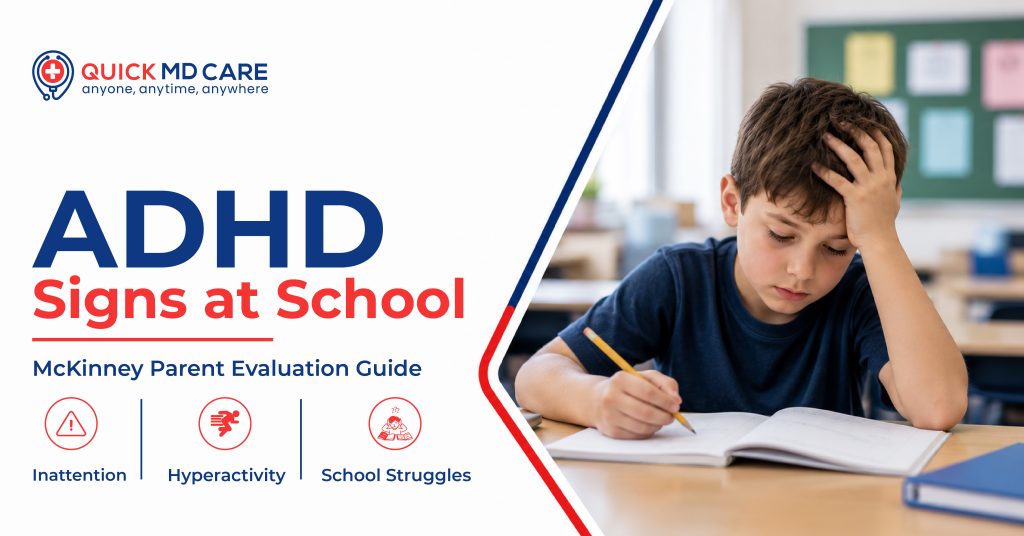
The teacher pulls you aside at pickup. Or it’s a comment on a report card. Or it’s a call from the school counselor that starts with “we’ve been noticing some things.”
And your stomach kind of drops, honestly, because part of you has been wondering too. The homework battles. The forgotten backpacks. The teacher says he’s joyful, but he just can’t seem to focus. That thing where she was the last one still working on the math worksheet, again.
You’re not overreacting for wondering. And you’re not being paranoid about looking into it. According to the CDC, about 7 million U.S. children — roughly 11.7% of kids ages 3 to 17 — currently have an ADHD diagnosis. In a class of 30, that’s three or four kids. So if the thought has crossed your mind, you’re in very good company.
Here’s the thing though. A lot of kids struggle to focus for reasons that aren’t ADHD at all. Anxiety looks a lot like it. So does undiagnosed hearing trouble. So does a kid going through a hard time at home. That’s why an actual evaluation matters, not to slap a label on your kid, but to figure out what’s really going on so you can help them.
 Why ADHD Signs Often Show Up at School First
For a lot of families, the first real ADHD signs don’t come from home. They come from teachers.
It makes sense when you think about it. Home is flexible. If your kid needs to get up and move around while doing homework, they can. If they need three snack breaks, sure. School is different. Sit still. Follow the rules. Listen. Stay on task. All at once, for hours.
That structure is where ADHD symptoms at school tend to jump out, because a classroom is basically the perfect environment to reveal them.
What teachers often notice first:
- Child cannot focus in class, drifts off constantly
- Blurts out answers, interrupts, has trouble waiting
- Can’t seem to sit still, fidgets, gets out of their seat
- Loses assignments, homework, pencils, jackets, everything
- Rushes through work and makes careless mistakes
- Trouble following multi-step directions
- Great one-on-one but falls apart in group settings
None of these on their own mean ADHD. But if teachers are noticing a pattern that keeps showing up across grades and settings, that’s worth paying attention to.
Signs of ADHD in Children: Inattentive and Hyperactive Symptoms
ADHD isn’t just “hyper.” That’s the biggest misconception, honestly, and it’s why so many kids, especially girls go undiagnosed for years. There are actually a few different ways ADHD symptoms in children can show up.
Inattentive ADHD Symptoms in Children look like:
- Trouble sustaining attention on schoolwork or play
- Doesn’t seem to listen when spoken to directly
- Doesn’t follow through on instructions or finish tasks
- Trouble organizing tasks, activities, or belongings
- Avoids or dislikes tasks that need mental effort
- Loses things constantly
- Easily distracted by outside stimuli
- Forgetful in daily activities
Hyperactive-Impulsive ADHD Symptoms in Children look like:
- Fidgets, taps hands or feet, squirms in seat
- Leaves seat when expected to stay put
- Runs or climbs when it’s not appropriate
- Can’t play quietly
- Always “on the go,” like they’re driven by a motor
- Talks excessively
- Blurts out answers before questions finish
- Trouble waiting their turn
- Interrupts or intrudes on others
A lot of kids have some combined type or a mix of both.
Here’s the piece parents often don’t know: the inattentive type is way easier to miss. A girl who’s quietly zoning out at her desk, doodling in the margin, looking out the window and she’s not causing trouble. So nobody flags her. But she might be struggling just as much as the kid bouncing off the walls. She’s just doing it quietly.
ADHD Signs at School by Age
ADHD symptoms in elementary school children tend to look a certain way, especially compared to older kids where it can shift.
In kindergarten and early elementary:
- Way more active than same-age peers
- Can’t sit through story time or circle time
- Talks constantly, interrupts
- Emotional meltdowns over small things
- Trouble making friends because of impulsive behavior
In grades 3-5:
- Work quality doesn’t match ability
- Homework takes forever
- Forgets to turn assignments in even after doing them
- Reading comprehension suffers because attention drifts
- Trouble with organization where the backpack is a disaster
In middle school and beyond, ADHD symptoms often shift toward the inattentive side. The hyperactivity may settle into more of an internal restlessness, while focus and organization problems can become more noticeable as the workload grows.
What Conditions Can Look Like ADHD in Children?
This is honestly one of the most important parts. Because a lot of things can look like ADHD but aren’t.
Anxiety is the big one. A child struggling with anxiety often can’t concentrate. They’re too busy worrying. They fidget. They’re irritable. They avoid difficult tasks. They can seem “distracted.” But the root is different, and the treatment is different too. About 40% of kids with ADHD also have anxiety, which makes the picture even more tangled.
Other things that can look like ADHD in children:
- Undiagnosed hearing or vision problems
- Learning disabilities like dyslexia
- Sleep problems (sleep-deprived kids look a lot like inattentive ADHD)
- Depression
- Trauma or stress at home whether it is a move, divorce, a loss
- Thyroid issues
- Absence seizures (rare, but real)
- Autism spectrum considerations
Can anxiety look like ADHD in children? Yes, absolutely. And so can several other things. Which is exactly why an evaluation matters. A good clinician isn’t just checking boxes on a symptom list. They’re ruling things out.
When Should a Child Be Evaluated for ADHD?
Honestly, the short answer is: whenever the pattern is affecting their life.
If your child is struggling academically despite being bright. If teachers keep flagging the same behaviors year after year. If homework has become a nightly battle that’s hurting your relationship with them. If your kid is beating themselves up about grades or focus. If they’re anxious about school, or don’t want to go. If friendships are hard because they interrupt or can’t take turns.
None of that has to reach some crisis point before it’s worth looking into. You don’t need to wait until they’re failing.
Officially, ADHD can be evaluated as early as age 4, though most evaluations happen in the early elementary years when school demands really ramp up. There’s no upper limit either — plenty of kids get diagnosed in middle school or high school when the workload catches up with them.
At what age can a child be evaluated for ADHD? Age 4 or older, per the American Academy of Pediatrics guidelines. Most evaluations happen between ages 6 and 12.
How Is ADHD Evaluated in Children?
Nobody diagnoses ADHD from one conversation. That’s important to know. A real evaluation is a process.
Here’s what a solid ADHD evaluation for children usually includes:
- A thorough medical history – because a lot of things need to be ruled out first
- Physical exam – including hearing and vision screening
- Detailed interviews with the parents about behavior at home
- Behavior rating scales filled out by both parents and teachers (this is huge – the teacher perspective often catches things parents don’t see)
- A look at academic records and any school assessments
- Screening for other conditions – anxiety, depression, learning disabilities, sleep issues
- Direct observation and interaction with the child
Some evaluations also include cognitive testing or neuropsychological assessment, especially when the picture is complicated or the child has other struggles.
Can a pediatrician evaluate a child for ADHD? Yes, for most straightforward cases, absolutely. Pediatricians and family medicine providers handle a lot of ADHD evaluations, especially in the elementary school years. If things are more complicated with significant co-occurring conditions, learning disabilities, or an unclear picture, go for a referral to a child psychologist or developmental pediatrician.
What Happens During a Child ADHD Evaluation?
For parents who’ve never been through this, the whole process can feel intimidating. It really doesn’t need to.
The first visit is usually a longer appointment where you talk through what’s been going on. What you’ve noticed at home. What teachers have flagged. When it started. How it’s affecting daily life. The provider will ask a lot of questions. It is not because they’re skeptical, but because context matters.
You’ll usually be given rating scale forms to complete, and copies to give to your child’s teachers. These take about 15-20 minutes each and are standardized (Vanderbilt or Conners are the most common).
Once everything’s back, there’s a follow-up visit to go over the findings. If it’s ADHD, you’ll talk through what type, how significant, and what the treatment options are. If it’s something else, or a mix, that gets discussed too along with a clear plan for next steps.
Treatment options usually include some combination of:
- Behavioral therapy and parent training
- School accommodations (a 504 plan or IEP)
- Environmental changes (routines, structure, tools)
- Medication, when appropriate
Not every kid needs medication. Not every kid does well without it. That’s a conversation between you, your child (when age-appropriate), and the provider, which is not a one-size-fits-all decision.
What NOT to do while you’re figuring this out
A few things that sometimes trip families up:
- Don’t self-diagnose from TikTok. Social media has done a lot of good for ADHD awareness, but it’s also full of oversimplifications. Real ADHD looks different in real kids.
- Don’t dismiss your kid’s teacher. If they’ve raised concerns, take it seriously. They see your child every day in a setting where the symptoms show up loudest.
- Don’t just push harder. “Try harder” doesn’t fix ADHD. A kid who genuinely can’t focus won’t do it just because you asked louder.
- Don’t wait for a full academic collapse. Earlier intervention is better. Way better. It protects self-esteem too.
- Don’t skip the physical. Get the medical stuff ruled out first. Hearing and vision problems get missed all the time.
How QuickMD Care approaches ADHD evaluations in McKinney
If you’re in McKinney, Frisco, Allen, or Plano, QuickMD Care is set up to be a first, calm stop when you’re worried about a child’s focus or behavior at school.
The pediatric care team can handle initial evaluations, coordinate with teachers on rating scales, rule out other medical issues, and either manage treatment directly or refer to a specialist when the picture calls for one.
What that usually looks like:
- Longer-than-standard appointments so there’s time to actually talk
- Standardized rating scales for both parents and teachers
- Physical exam plus hearing and vision screening
- Screening for co-occurring conditions like anxiety and sleep issues
- A clear treatment plan of behavioral, environmental, and medication if it fits
- Ongoing follow-up, because ADHD care isn’t a one-visit thing
For families searching for a pediatric ADHD doctor McKinney or an ADHD evaluation for children McKinney TX, this is what a good starting point looks like.Not rushed. Not dismissive. Not stapling a diagnosis on the first visit.
The primary care side also supports older teens and college-age patients navigating ADHD as they get older, because it doesn’t magically disappear at 18.
Common Parent Questions About ADHD in Children
What are the first signs of ADHD at school? Trouble focusing, not finishing work, blurting out, difficulty following directions, losing things constantly, or major fidgeting and inability to sit still. Teachers usually notice the pattern before parents do.
At what age can a child be evaluated for ADHD? Age 4 and up, per American Academy of Pediatrics guidelines. Most evaluations happen between ages 6 and 12.
Can anxiety look like ADHD in children? Yes — anxious kids often have trouble concentrating, seem restless, and avoid challenging tasks. It’s one of the most commonly confused conditions, and about 40% of kids with ADHD also have anxiety.
What conditions can look like ADHD in children? Anxiety, depression, sleep problems, hearing or vision issues, learning disabilities, trauma or stress at home, thyroid problems, and occasionally certain seizure types.
How is ADHD evaluated in children? A combination of medical history, physical exam, behavior rating scales from parents and teachers, a look at school records, and screening for other conditions that could explain the symptoms.
Can a pediatrician evaluate a child for ADHD? Yes, for most cases. More complex situations may involve a psychologist or developmental pediatrician.
What happens during a child ADHD evaluation? An initial in-depth appointment, rating scales completed by parents and teachers, and a follow-up visit to go over findings and plan next steps.
Does my child need medication? Not necessarily. Treatment usually combines behavioral strategies, school accommodations, and sometimes medication — and it’s an individual decision, not a default.
What if the diagnosis is wrong? That’s why a real evaluation includes ruling other things out. If treatment isn’t working, that’s information too, and the plan can be adjusted.
Where to trust the guidance
Reliable information about pediatric ADHD comes from a small handful of sources:
- The CDC’s ADHD data page has current U.S. prevalence and treatment stats
- The American Academy of Pediatrics publishes the clinical guidelines most pediatricians follow
- CHADD (Children and Adults with ADHD) has parent-friendly resources
- The NCHS data brief on ADHD in children ages 5-17 is worth a look if you want the demographics and trends
Beyond that, the person who can actually help with your specific kid is a provider who does these evaluations regularly and takes the time to look at the full picture, not just check boxes.
When It’s Time to Book an ADHD Evaluation
If teachers keep flagging concerns. If homework is a nightly battle. If your kid is struggling and starting to feel bad about themselves for it. If you’ve been quietly wondering for a while — that’s a good time to make the call.
Call QuickMD Care in McKinney at (972) 645-9400 or book an appointment online. The team can walk you through what an evaluation looks like and start the process with no pressure, no rush, no assumptions.
Whether it turns out to be ADHD, anxiety, something else, or a combination and the answer is worth having.
More From QuickMD Care
- Primary care, hypertension management, and preventive checkups – Primary Care Services
- Full list of clinic services including labs and diagnostics – Services Overview
- Family and pediatric care – Pediatric Care
- Best School Physicals in McKinney, TX: Your Complete Guide:
https://www.quickmdcare.com/best-school-physicals-in-mckinney-tx-your-complete-guide/ - Top 10 Budget-Friendly Protein Foods for Toddlers: Dietary Consult in McKinney, TX:
https://www.quickmdcare.com/top-10-budget-friendly-protein-foods-for-toddlers-dietary-consult-in-mckinney-tx/ - Why Prenatal Visits Near McKinney, TX Are a Lifeline for Expecting Moms:
https://www.quickmdcare.com/why-prenatal-visits-near-mckinney-tx-are-a-lifeline-for-expecting-moms/ - Well Child Care: Why Regular Checkups Matter for Your Child’s Health:
https://www.quickmdcare.com/well-child-care/ - 10 Iron-Rich Foods for Adults in 2026: Boost Your Energy and Health: https://www.quickmdcare.com/10-iron-rich-foods-for-adults-in-2026-boost-your-energy-and-health/
- AAP Releases its Recommended 2026 Childhood and Adolescent Immunization Schedule – Don’t Miss:https://www.quickmdcare.com/aap-releases-its-recommended-2026-childhood-and-adolescent-immunization-schedule/
- Swimmer’s Ear vs. Ear Infection in Kids: Summer Signs Parents Shouldn’t Ignore : https://www.quickmdcare.com/swimmers-ear-vs-ear-infection-in-kids-summer-signs-parents-shouldnt-ignore/
- Best Summer Foods for Adults & Kids: Stay Hydrated, Energized, and Healthy:https://www.quickmdcare.com/best-summer-foods-for-adults-kids-stay-hydrated-energized-and-healthy/
- Summer Sports Injuries in Kids: When Pain or Swelling Needs an X-Ray: https://www.quickmdcare.com/summer-sports-injuries-in-kids-when-pain-or-swelling-needs-an-x-ray/
- High Blood Pressure at Home: When Should You See a Doctor? : https://www.quickmdcare.com/high-blood-pressure-at-home-when-should-you-see-a-doctor/
- Back-to-School Pediatric Checklist: Health Signs Parents Should Review: https://www.quickmdcare.com/back-to-school-pediatric-checklist-for-mckinney-parents/
Watching your child struggle at school is hard. Watching them start to internalize it. “I’m bad at this,” “I’m the dumb one,” “school hates me” is worse. The whole point of an evaluation isn’t to label your kid. It’s to understand what’s happening so you can actually help.
If that pattern of concern has been building for a while, it’s okay to make the call. QuickMD Care in McKinney is a warm, thorough place to start.
About QuickMD Care
QuickMD Care offers family-focused treatment, including highly qualified services in both pediatrics and adults under a single, well-equipped and patient-friendly clinic. The team provides patients with timely care in the most compassionate manner, including basic checkups and addressing unexpected issues. When families are seeking a reliable primary care physician McKinney or quick urgent care pediatrics McKinney, TX, they will find the quality and convenience of QuickMD Primary Care.
10101 Westridge Blvd, Suite 101
McKinney, TX 75070
New location : Avondale/Haslet ,Texas -76052
Phone: 972-645-9400
Website: quickmdcare.com Quick MD Care