Here’s a stat that stops most people in their tracks. According to a recent JAMA study of over a decade of NHANES data, nearly 4 in 10 U.S. adults now meet the criteria for metabolic syndrome. Among adults 60 and older, it climbed to over 62%.
And most of them don’t know it. Because metabolic health, unlike a broken ankle or the flu, doesn’t hurt. It just quietly builds in the background, until one day it doesn’t.
The frustrating thing is, you can look fine, feel fine, weigh what you weighed in college, and still have five metabolic health numbers that would make your doctor sit up a little straighter.That’s honestly the whole point of an annual physical. Not to lecture you about kale. To catch the numbers early enough to actually do something about them.
So let’s talk about what metabolic health really means, the five numbers worth checking, and what to do with the answers.
What is metabolic health, really?
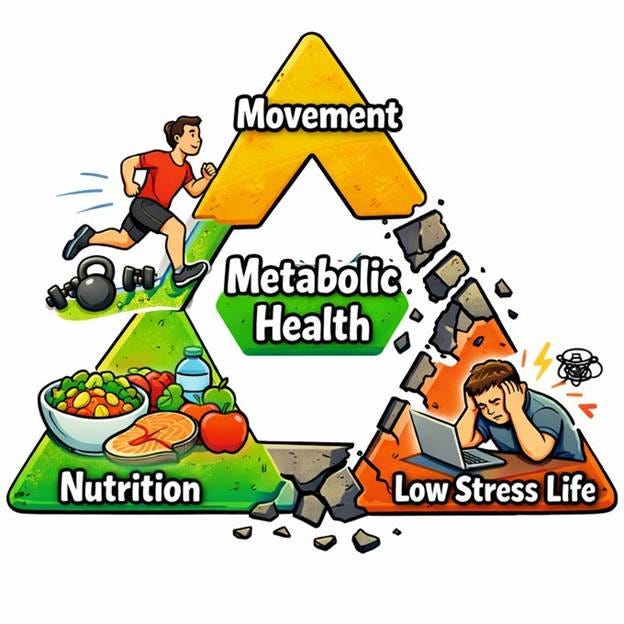
Metabolic health is basically how well your body is handling the day-to-day work of processing food, managing blood sugar, storing fat, and keeping your cardiovascular system running smoothly. It’s not one thing — it’s a cluster of things all working together (or not).
What does good metabolic health mean?
- Blood sugar stays stable
- Cholesterol and triglycerides are in a healthy range
- Blood pressure is normal
- Body fat is at a level that doesn’t strain your organs
- Insulin is doing its job efficiently
When those pieces are off, even a little, the system starts compensating. And that quiet compensation is where problems like type 2 diabetes, heart disease, fatty liver, and stroke start their long, slow buildup. Often decades before diagnosis.
Here’s what makes it especially tricky. You can be “normal weight” and metabolically unhealthy. You can be overweight and metabolically healthy. The scale is just one small piece of a much bigger picture.
Signs of poor metabolic health
A lot of people don’t have obvious symptoms. That’s kind of the whole problem. But some subtle signs are worth paying attention to.
- Constant fatigue, especially in the afternoons
- Cravings for sugar or carbs
- Weight gain around the middle (even without eating differently)
- Trouble sleeping, or waking up unrefreshed
- Skin tags or darkened patches at the neck or armpits (a possible insulin resistance clue)
- Brain fog
- Feeling shaky or hungry between meals
Insulin resistance symptoms in particular can be really quiet. It’s your body’s cells becoming less responsive to insulin over time, and it often shows up as weight around the belly, energy crashes, and increased hunger long before blood sugar itself starts running high.
If any of that sounds familiar, that’s not a diagnosis. It’s just a nudge to get the actual numbers looked at.
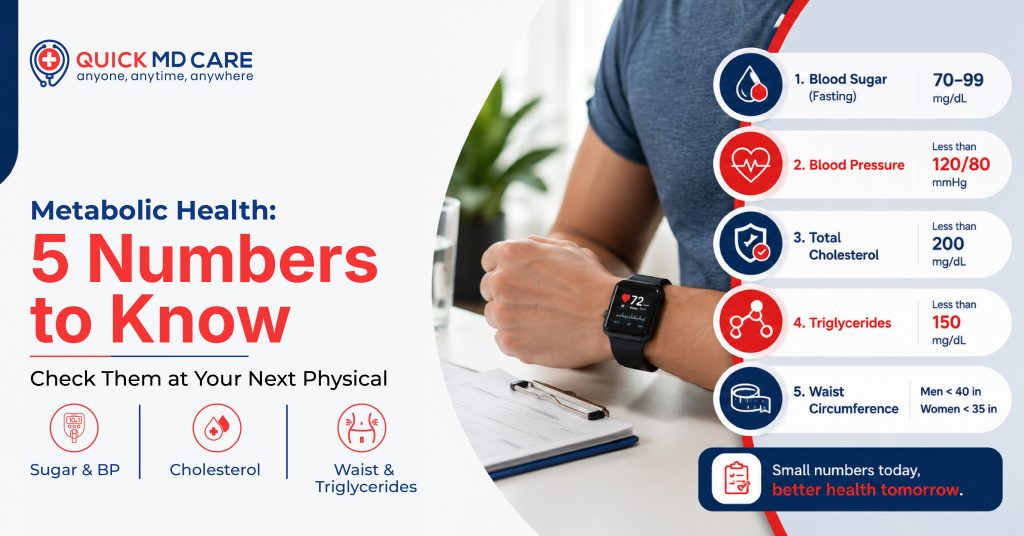
The five numbers to check at your next physical
These are the ones that matter for cardiometabolic health and they’re all things your primary care doctor already runs at a routine annual physical. You just want to make sure they get discussed, not glanced at.
- Fasting blood sugar (and A1C)
Fasting blood sugar tells you what your blood glucose looks like after 8+ hours without eating. A1C tells you your average blood sugar over the last 2-3 months. Together, they give a real picture.
What does an A1C test measure? It measures the percentage of hemoglobin in your blood that has glucose attached, giving a picture of your average blood sugar over the past 2-3 months.
- Fasting glucose under 100 mg/dL is normal
- 100-125 mg/dL is prediabetes
- 126+ mg/dL on two tests = diabetes
- A1C under 5.7% is normal
- 5.7-6.4% is prediabetes
- 6.5% or higher is diabetes
If you’re concerned about high blood sugar, or you have a family history of diabetes, these are the numbers to watch closely.
- Blood pressure
Blood pressure is one of the few metabolic markers you can check between doctor visits with a home cuff, and it’s worth doing.
- Normal: under 120/80
- Elevated: 120-129 systolic, under 80 diastolic
- Stage 1 hypertension: 130-139 / 80-89
- Stage 2 hypertension: 140+ / 90+
If your blood pressure comes back elevated at an annual physical, that’s a starting point for repeat monitoring and a real conversation about lifestyle and, if needed, medication.
- Triglycerides
Why are triglycerides important for health? They’re a type of fat in your blood, mostly produced when you eat more calories (especially from carbs and sugar) than your body needs right away. Elevated triglycerides are a strong signal that something’s off metabolically.
- Normal: under 150 mg/dL
- Borderline: 150-199
- High: 200-499
- Very high: 500+
High triglycerides often show up before other markers do — which makes them a useful early warning sign.
- HDL cholesterol
What does HDL cholesterol mean? HDL is the “good” cholesterol — it helps clear other kinds of cholesterol out of your blood. Low HDL is a red flag for cardiovascular risk.
- Men: HDL should be 40 mg/dL or higher
- Women: HDL should be 50 mg/dL or higher
Low HDL doesn’t get talked about as much as high LDL, but it’s actually one of the five core metabolic syndrome markers. It’s worth asking about specifically.
- Waist circumference
This one’s often skipped at physicals, but it matters more than BMI for metabolic risk. Belly fat is metabolically active in ways that hip and thigh fat isn’t — it releases inflammatory chemicals and interferes with insulin.
- Men: waist over 40 inches = elevated risk
- Women: waist over 35 inches = elevated risk
Measure at the belly button, standing up, not sucking in. That’s the honest number.
What are the five markers of metabolic health?
Put together, these are the five markers viz. fasting blood sugar, blood pressure, triglycerides, HDL cholesterol, and waist circumference. These are the pieces that make up metabolic syndrome. If three or more are out of range, that’s the technical diagnosis.
Metabolic syndrome risk factors are essentially the individual markers being off. There’s no distinct “metabolic syndrome pain.” It’s the cluster itself that raises your risk.
Which is why the annual physical actually matters. It’s the one place all five of these get looked at together, in context.
What if the numbers aren’t great?
First, take a breath. Almost nobody has all five in the perfect range. Slightly elevated numbers aren’t a diagnosis. They’re information.
If something comes back off:
- Blood pressure high? A few weeks of home monitoring, plus a plan. Lifestyle changes work here, and medication is available if needed.
- Blood sugar elevated? Prediabetes can often be improved. Diet, movement, and lifestyle changes can make a real difference over time.
- High triglycerides or low HDL? Both respond well to lifestyle changes, especially reducing added sugar and refined carbs, and adding regular movement.
- Waist circumference up? Belly fat is often the first thing to respond to diet and exercise changes.
What if my cholesterol is high? That’s a longer conversation with your doctor. They’ll want to look at LDL, HDL, triglycerides, and total cholesterol together, along with your other risk factors. Sometimes it’s a lifestyle. Sometimes it’s genetic. Often it’s both.
The point isn’t to panic about a number. It’s to understand what it means and take steps early, because early action can make these risk factors easier to manage.
How often should adults get metabolic health screening?
For most adults, once a year at an annual physical is standard. That covers blood pressure, cholesterol panel (which includes triglycerides and HDL), and either fasting glucose or A1C.
Some situations call for more frequent checking:
- Family history of diabetes, heart disease, or stroke
- Personal history of gestational diabetes
- Overweight, especially with belly fat
- High blood pressure already diagnosed
- Age 45+
- Any prediabetes finding
If you’ve already been flagged for something like prediabetes, borderline blood pressure, or high triglycerides, you may need more frequent monitoring. Your primary care doctor will guide the timing.
What to actually do at your annual physical
If you want to get the most out of it, come prepared. Physicals move fast, and it’s easy to leave without having really discussed anything.
- Ask whether fasting is required before the appointment if bloodwork is planned.
- Bring a list of medications and supplements
- Write down any symptoms or concerns – even the vague ones
- Ask for a copy of your bloodwork afterward, not just a “you’re fine” summary
- Ask specifically about your metabolic markers – the five numbers above
- If something’s off, ask for a plan – not just “we’ll watch it”
Can an annual physical detect metabolic problems? Yes. An annual physical can help identify metabolic risk factors early.But it only works if you actually get one, and if the results actually get discussed.
Common mistakes adults make with metabolic health
The patterns primary care providers see over and over:
- Skipping the annual physical for years at a stretch. Numbers can shift a lot in that time.
- Looking at the scale instead of the actual metabolic markers. Weight is one data point. It’s not the most important one.
- Ignoring “borderline” results. Borderline is when action works best.
- Assuming feeling fine = being fine. Metabolic problems are quiet for years.
- Not asking for the actual numbers. “Normal” is a range. Knowing where you fall in it matters.
- Waiting for a big scary result before making changes.
- Trying to overhaul everything at once. Small, sustainable changes beat dramatic short-term ones.
How QuickMD Care Supports Metabolic Health Screening in McKinney
If you’re in McKinney, Frisco, Allen, or Plano and haven’t had a physical in a while — or you have but you’re not sure your numbers were actually explained — QuickMD Care is a straightforward place to start.
The primary care team handles annual physicals, metabolic health screenings, and follow-up when something needs attention.Bloodwork is done in-office, results come with actual conversation, and follow-up plans aren’t rushed.
What that usually looks like:
- Comprehensive annual physical with metabolic panel
- Blood pressure, glucose, A1C, lipid panel, and waist measurement all reviewed together
- Clear explanation of what each number means for you specifically
- Personalized plan if something’s off like diet, exercise, and medication conversations
- Follow-up scheduling built in, so nothing falls through the cracks
- Referrals to endocrinology, cardiology, or nutrition when the picture calls for it
For anyone searching metabolic health screening McKinney TX or annual physical McKinney TX, this is what a thorough, useful physical should look like.
The full clinic services page also covers labs, chronic disease management, and preventive care under one roof, so you’re not being sent to five different places.
Common questions
What does good metabolic health mean? Stable blood sugar, healthy cholesterol and triglycerides, normal blood pressure, and a waist measurement in a healthy range. All five, in balance.
What are the five metabolic health numbers? Fasting blood sugar (and A1C), blood pressure, triglycerides, HDL cholesterol, and waist circumference.
Can an annual physical detect metabolic problems? Yes. It’s designed to catch exactly these issues, often years before symptoms appear.
How often should adults get metabolic health screening? At minimum, once a year. More often if you have risk factors, family history, or borderline results.
What does an A1C test measure? Your average blood sugar over the past 2-3 months, expressed as a percentage. It’s a better long-term indicator than a single fasting glucose reading.
Why are triglycerides important for health? Elevated triglycerides can be an important sign of metabolic and cardiovascular risk and may be influenced by diet, carbohydrate intake, insulin function, and other factors.
What does HDL cholesterol mean? It’s the “good” cholesterol that helps clear other cholesterol from your blood. Low HDL is a cardiovascular risk factor.
How do I know if I am metabolically healthy? The only real way is to get the five numbers checked. Symptoms can be quiet for years even when numbers are off.
Can I improve metabolic health without medication? Often, yes! It is especially for prediabetes, borderline blood pressure, and lipid issues. Diet, movement, sleep, and stress management all move the needle. Medication is a tool, not always the first tool.
What lifestyle changes help most? Cutting added sugar, reducing refined carbs, moving daily (even just walking), sleeping 7-9 hours consistently, and managing stress. Consistency beats intensity every time.
Where the trustworthy guidance lives
Reliable information about metabolic health comes from a small handful of sources:
- The CDC’s data on metabolic syndrome and diabetes covers current U.S. numbers
- The JAMA study on metabolic syndrome trends tracks how prevalence has shifted over the last decade
- The American Heart Association publishes the clinical criteria most doctors follow
- The American Diabetes Association covers blood sugar and A1C guidance
But the person who can actually help with your specific numbers is your primary care doctor, like someone who knows your history, your family history, and how the whole picture fits together for you.
More From QuickMD Care
- Primary care, hypertension management, and preventive checkups – Primary Care Services
- Full list of clinic services including labs and diagnostics – Services Overview
- Family and pediatric care – Pediatric Care
- Best School Physicals in McKinney, TX: Your Complete Guide:
https://www.quickmdcare.com/best-school-physicals-in-mckinney-tx-your-complete-guide/ - Top 10 Budget-Friendly Protein Foods for Toddlers: Dietary Consult in McKinney, TX:
https://www.quickmdcare.com/top-10-budget-friendly-protein-foods-for-toddlers-dietary-consult-in-mckinney-tx/ - Why Prenatal Visits Near McKinney, TX Are a Lifeline for Expecting Moms:
https://www.quickmdcare.com/why-prenatal-visits-near-mckinney-tx-are-a-lifeline-for-expecting-moms/ - Well Child Care: Why Regular Checkups Matter for Your Child’s Health:
https://www.quickmdcare.com/well-child-care/ - 10 Iron-Rich Foods for Adults in 2026: Boost Your Energy and Health: https://www.quickmdcare.com/10-iron-rich-foods-for-adults-in-2026-boost-your-energy-and-health/
- AAP Releases its Recommended 2026 Childhood and Adolescent Immunization Schedule – Don’t Miss:https://www.quickmdcare.com/aap-releases-its-recommended-2026-childhood-and-adolescent-immunization-schedule/
- Swimmer’s Ear vs. Ear Infection in Kids: Summer Signs Parents Shouldn’t Ignore : https://www.quickmdcare.com/swimmers-ear-vs-ear-infection-in-kids-summer-signs-parents-shouldnt-ignore/
- Best Summer Foods for Adults & Kids: Stay Hydrated, Energized, and Healthy:https://www.quickmdcare.com/best-summer-foods-for-adults-kids-stay-hydrated-energized-and-healthy/
- Summer Sports Injuries in Kids: When Pain or Swelling Needs an X-Ray: https://www.quickmdcare.com/summer-sports-injuries-in-kids-when-pain-or-swelling-needs-an-x-ray/
- High Blood Pressure at Home: When Should You See a Doctor? : https://www.quickmdcare.com/high-blood-pressure-at-home-when-should-you-see-a-doctor/
- Back-to-School Pediatric Checklist: Health Signs Parents Should Review: https://www.quickmdcare.com/back-to-school-pediatric-checklist-for-mckinney-parents/
Ready to get checked?
If it’s been a year, or three, since your last physical, that’s the sign to book one.
Call QuickMD Care in McKinney at (972) 645-9400 or book an annual physical online. Comprehensive metabolic screening, real conversations about your numbers, and a clear plan if anything needs attention.
Not sure what you actually need? Come in for the physical. Five numbers is all it takes to know if you’re building health or quietly losing it.
About QuickMD Care
QuickMD Care offers family-focused treatment, including highly qualified services in both pediatrics and adults under a single, well-equipped and patient-friendly clinic. The team provides patients with timely care in the most compassionate manner, including basic checkups and addressing unexpected issues. When families are seeking a reliable primary care physician McKinney or quick urgent care pediatrics McKinney, TX, they will find the quality and convenience of QuickMD Primary Care.
10101 Westridge Blvd, Suite 101
McKinney, TX 75070
New location : Avondale/Haslet ,Texas -76052
Phone: 972-645-9400
Website: quickmdcare.com Quick MD Care